Funeral Thank-You Card Etiquette: Who, When and How
There are no hard rules for thank-you cards after a funeral. There are some customs, and knowing them can make the job smaller. Not everyone on the guest book needs a card. There is no deadline. Someone else in the family can write them.
Send a funeral thank-you card to anyone who did something specific for your family: sent flowers, gave to a charity, brought food, wrote a personal note, or helped with the service. Most families send them within a few weeks to two months. A short note, signed for the family, is enough, and a later card is fine.
Below: the checklist of who gets a card (it doubles as your mailing list), who doesn't need one, timing, who writes and signs, typed or handwritten, how to address each card, and how to find the addresses.
Contents
- Do you send thank-you cards after a funeral?
- Who gets a funeral thank-you card?
- Who doesn't need a card?
- Do you send thank-you cards for sympathy cards?
- When should you send funeral thank-you cards?
- Who writes and signs the cards?
- Typed or handwritten?
- How do you address funeral thank-you cards?
- How do you find everyone's address?
- Is a thank-you in the obituary enough?
- Is a postcard all right for a funeral thank-you?
- Sending the cards
Do you send thank-you cards after a funeral?
Yes, most families do, though not to everyone. The custom is a short card to the people who did something for the family: flowers, a donation, food, a personal note, a role in the service, or practical help. People who came to the service and signed the guest book don't need one, though a family may send one to them too.
If the list is long, ShipNote can print and mail the cards for you. You paste the list you already have, whether that's the guest book, the florist's cards, the charity's list or a photo of a notebook page. You write one note. Each card names that person and what they did: "Thank you for the white lilies", "Thank you for being with us at the service." The cards are printed, stamped and mailed the next business day, or held until a date you choose.
Who gets a funeral thank-you card?
Use this as a checklist. Each line is a group of names, and together they are the mailing list.
| Who | What to thank them for |
|---|---|
| Anyone who sent flowers or a plant | The flowers, by name if you know them |
| Anyone who gave to a charity in the person's memory | The gift, never the amount |
| Anyone who sent money or a sympathy gift | Their generosity, or the gift itself |
| Anyone who brought food or organized meals | The meals |
| Anyone who sent a personal note | Their kind words |
| Anyone who sent a Mass card | Remembering the person this way |
| The pallbearers | Serving as a pallbearer |
| The officiant, and anyone who gave a eulogy or a reading | Leading the service, or what they said |
| Musicians and anyone who helped with the reception | Their part in the day |
| The funeral director and staff | Their care |
| Hospice staff, nurses and caregivers | Their care in the last weeks |
| Neighbors and friends who helped at home | The specific help: meals, the lawn, the dog |
| Anyone who travelled a long way to be there | Making the trip |
| A coworker group or employer that sent something | One card to the group |
For messages for each of these, see funeral thank-you card wording, and for flowers, donations and food, thank-you notes for funeral flowers.
Who doesn't need a card?
- Everyone who signed the guest book. Coming to the visitation or the service is a kindness, but it doesn't call for a card. Send one if you'd like to.
- People who left a message in the online guestbook. A short thank-you posted in the same guestbook, or in the obituary, covers them.
- People who sent a printed sympathy card with only a signature. A card is optional here. Many families send one anyway.
- People in your own household. Thank them in person.
- Anyone you already thanked properly in person, for something small.
When you aren't sure, sending a card is never wrong. Not sending one isn't wrong either.
Do you send thank-you cards for sympathy cards?
You don't have to. A store-bought sympathy card with a signature is usually acknowledged by a general thank-you, if at all. A sympathy card with a personal note, a story or a memory is different, and many families answer it with a short card: "Thank you for your kind words, and for the story about the summer at the lake."
If a sympathy card came with a gift, a donation or a check, send a card for the gift.
When should you send funeral thank-you cards?
Most families send them within a few weeks to two months of the service. There is no deadline. Some sources say two to four weeks. That is a guide, not a rule, and nobody expects a grieving family to keep to it. If more time has passed, send them anyway. A late card can say so in one line: "We are later with this note than we meant to be, and your patience has been one more kindness."
It helps to start the list in the first week, while the florist's cards, the guest book and the charity's list are all in one place. You can write the cards later.
If you'd rather order the cards now and have them arrive later, ShipNote can hold them and mail them on a day you choose, up to 90 days out.
Who writes and signs the cards?
Anyone in the family can write them. The person closest to the one who died doesn't have to do it alone, and often shouldn't. Common ways to split it:
- By relationship. Each sibling writes to their own friends, coworkers and in-laws.
- By group. One person takes the flowers and donations, another the service and the helpers.
- One person for everyone. A son, a daughter-in-law or a close friend writes them all and signs for the family.
Sign as the family ("The Lee Family"), with both names for a couple, or with your own name. When one person writes for everyone, a line such as "On behalf of all of us" makes that clear.
Typed or handwritten?
Either is acceptable. A handwritten card is the traditional choice. A typed or printed card is fine when the note is specific: it names the person and what they did, and it's signed for the family. A printed "Thank you for your kindness" with no name reads as a form. A printed "Dear Carol, thank you for the white lilies" doesn't.
Many families handwrite a few cards, to the closest family and friends, and send printed ones to the rest of a long list. For more on the general question, see do thank-you cards have to be handwritten.
How do you address funeral thank-you cards?
Address each card the way you would any formal card, to the people who sent the gift.
| Who | On the envelope or card |
|---|---|
| A couple | David and Grace Okafor |
| A whole family | The Okafor Family |
| One person | Carol Nguyen |
| An office or team | The staff of Harris Realty, with the address of the office |
| A church or congregation | The person who led the service by name and title, at the church's address |
| The funeral home | The funeral director by name, at the funeral home |
| Hospice or a hospital unit | The hospice team, or the unit by name, at its address |
Inside, the greeting matches: "Dear David and Grace," "Dear Okafor Family," "Dear friends at Harris Realty,". A first name is fine for anyone you'd call by their first name.
How do you find everyone's address?
Start with what the funeral gave you, then fill the gaps:
- The guest book. Many guest books have a line for an address. Take a photo of each page.
- The funeral home. Ask for the florist's cards, the list of flowers and any memorial book. Some funeral homes also keep an online guestbook for the obituary.
- The obituary's online guestbook. It gives you names, and sometimes a city, but rarely a street address.
- The charity's acknowledgement list. Charities that receive gifts in someone's memory usually send the family the names and addresses of the people who gave.
- Family. Someone always has the address book, the holiday-card list or the phone with everyone's details.
If you still have a name and no address, ShipNote can ask for it. Keep the name on your list; when you press Next: Review, that row is flagged and offers a link you can text the person. They type in their own address, and their card comes back addressed while the rest of the list mails.
Is a thank-you in the obituary enough?
For some people, yes. A short public thank-you, in the newspaper, on the obituary page or in the funeral home's online guestbook, acknowledges everyone who came, called or wrote. It's a kind way to reach people you can't name.
It doesn't replace cards to the people who did something specific. Flowers, donations, meals and a role in the service each still get their own card.
Is a postcard all right for a funeral thank-you?
Yes, for most of the list, but it's worth knowing what a postcard is. ShipNote's cards are 4x6 postcards printed on both sides: the design on the front, and your note and the address on the back. There is no envelope, so the note can be read by anyone who handles the mail.
For a short thank-you ("Thank you for the white lilies. They were beautiful, and they meant so much to all of us"), that is no different from a note card left on a table. Some notes are better in an envelope: a long, personal letter to a close friend, a note about something private, or a card to someone you know would expect a folded card. Write those few by hand in a folded card. ShipNote doesn't make folded cards.
Sending the cards
With the checklist done, you have a list of names and what each person did. That list is the hard part. Writing the same kind of note to each name is the long part.
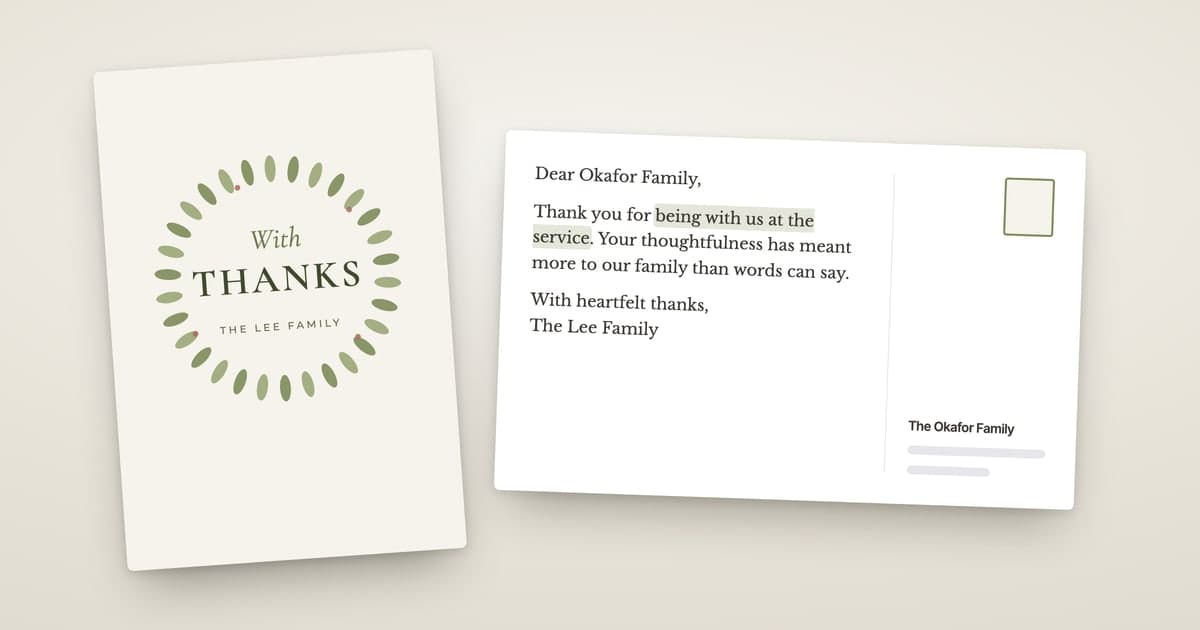
On ShipNote, you paste that list or upload a photo of it, and write one note. Each card fills in its own name and what that person did, so the card for the Okafor family reads "Thank you for being with us at the service" and a row with only a name reads "Thank you for your kindness and support." The cards open on the Botanical design, a laurel wreath and "With Thanks", with no photograph. You can open any single card on the review step and add a line. They cost $1.99 a card on 10 or more, or $2.49 a card for fewer, with First-Class postage included, and they are printed, stamped and mailed the next business day.
Paste the guest book or the florist's cards, write one note, and every card is mailed for you.
Related reading
- Funeral thank-you card wording: more than 50 messages from the family, by who you are thanking.
- Thank-you notes for funeral flowers, donations and food: what to write for each kind of gift, and how to find out who sent what.
- Do thank-you cards have to be handwritten?: when a printed card is the right call.
A long list to thank?
Paste the list, write one note, and each card names that person and what they did. We print, stamp and mail every one.
Write the cardsCommon questions
Most families send them within a few weeks to two months of the service. There is no firm deadline, and nobody expects a grieving family to be quick. A card sent later is still welcome, and it can say so in one line.
No. Signing the guest book or coming to the visitation doesn't call for a card, though some families send one to everyone. Cards go to the people who did something specific: sent flowers, gave to a charity, brought food, sent a personal note, or helped with the service.
No. People understand that grief comes first. Many families send cards because they want to, and a short note to the people who helped most is enough. If writing them all is too much, a family member can write them, or the family can post one thank-you in the obituary or the funeral home's online guestbook.
Yes. A printed card is acceptable when the note is specific: it names the person and what they did, and it is signed by the family. What matters is that the card thanks that person for that kindness, not how the words got onto it.