
How to Write a Thank-You Note: 6 Steps, With Examples
A thank-you note has six parts, and every good one uses the same shape: greet the person, thank them for the specific thing, add one detail only they could get, look ahead, thank them again, and sign your name. Once you know the shape, writing one takes about five minutes, and writing forty takes an evening.
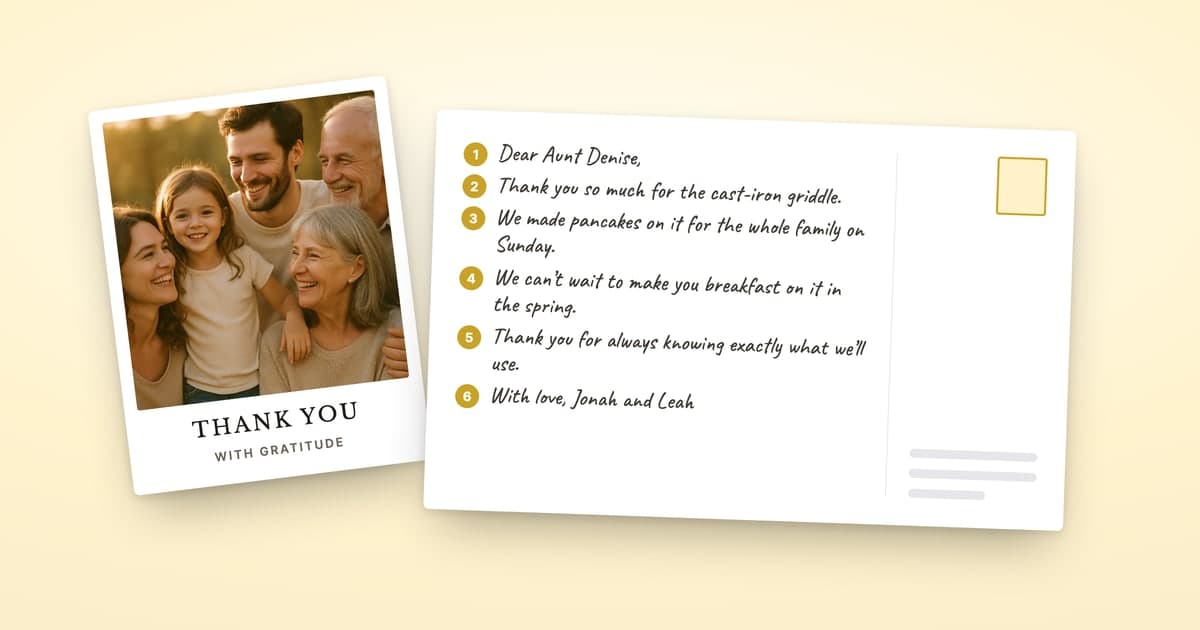
How to write a thank-you note, in short: open with "Dear" and their name, thank them for the gift or kindness by name, say how you've used it or why it mattered, add a line about seeing them or what they mean to you, repeat the thanks, and sign off. About four sentences is the right length for most notes. Here is a whole one:
Dear Aunt Denise,
Thank you so much for the cast-iron griddle. We made pancakes on it for the whole family on Sunday, and not one stuck. We can't wait to make you breakfast on it when you visit in the spring. Thank you for always knowing exactly what we'll use.
With love, Jonah and Leah
Below: each of the six steps with weak and strong versions, how long to write, worked notes for ten occasions plus money and a scholarship, the mistakes that make a note read like a form, and how to write a whole list of them without writing each one from scratch.
Contents
- What goes in a thank-you note?
- What do you need before you start writing?
- Step 1: How do you start a thank-you note?
- How do you address a thank-you card?
- Step 2: How do you say thank you for the specific thing?
- Step 3: What goes in the middle of a thank-you note?
- Step 4: How do you look ahead in a thank-you note?
- Step 5: How do you end a thank-you note?
- Step 6: How do you sign a thank-you note?
- How long should a thank-you note be?
- Thank-you note examples for every occasion
- How do you write a thank-you note for money?
- How do you write a thank-you note for a scholarship?
- Should a thank-you note be handwritten, printed or emailed?
- What mistakes make a thank-you note feel generic?
- How do you write thank-you notes for a whole list?
What goes in a thank-you note?
A thank-you note has six parts: a greeting, a thank-you that names the specific gift or kindness, one personal detail, a line that looks ahead, a closing thank-you, and a sign-off. The first two and the last are required. The detail is what separates a note someone keeps from one they skim, so it's the part worth your effort.
| Step | Part | What it does | Example |
|---|---|---|---|
| 1 | Greeting | Opens with the person, by name | Dear Aunt Denise, |
| 2 | The thanks | Names exactly what they gave or did | Thank you so much for the cast-iron griddle. |
| 3 | The detail | Proves it landed | We made pancakes on it for the whole family on Sunday. |
| 4 | Looking ahead | Turns from the gift to the person | We can't wait to make you breakfast on it in the spring. |
| 5 | Thanks again | Ends on gratitude or a thought about them | Thank you for always knowing exactly what we'll use. |
| 6 | Sign-off | Tone, then every name the thanks is from | With love, Jonah and Leah |
This is close to the order the Emily Post Institute's guide to thank-you notes gives, sentence by sentence: "Thank them explicitly for the specific gift or act", then "Personalize the note with an original thought", then an optional sentence to "Pull the focus back and think about the future", and finally "repeat the thanks or offer a concluding thought". Step 4 is the optional one. On a small card or a short note to a coworker, you can drop it.
What do you need before you start writing?
Three things: a list of who gave what, the name you call each person, and a mailing address for each. Most of the time lost on thank-you notes isn't the writing. It's stopping mid-card to work out who sent the salad bowl or to dig up an address.
- Who gave what. Write it down as gifts arrive, or pull it from the registry: Amazon, Zola and Babylist each keep a list of gifts and who bought them. A note that thanks someone for the wrong gift is worse than a late one.
- The name you'd say out loud. "Aunt Denise," not "Denise Halloran," and "Mr. Castellano" if that's what you called him growing up. The greeting should sound like you.
- An address for every card. Many registries don't share guests' addresses. Ask a parent, check a wedding RSVP list, or send the guest a quick text.
- A deadline. Aim for within two weeks of the gift or the event. Wedding gifts that arrive on or after the day get a longer window, about three months; our wedding thank-you etiquette guide has the details.
With the list in front of you, each note is a matter of filling in the six steps.
Step 1: How do you start a thank-you note?
Start with "Dear" and the name you would call the person out loud, followed by a comma: "Dear Aunt Denise," or "Dear Mr. Castellano,". Then begin the thanks in the very next sentence. The greeting sets the tone for everything after it, so match it to how you talk to this person.
| Relationship | Greeting |
|---|---|
| Family | Dear Grandma June, / Dear Uncle Pete, |
| Friends | Dear Carmen, / Hi Carmen, |
| A couple or family | Dear Pete and Lorna, / Dear Castellano family, |
| A teacher, boss or elder | Dear Mr. Castellano, / Dear Dr. Farris, |
| A committee or foundation | Dear members of the scholarship committee, |
Leave the wind-up out of the opening:
- Weak: "I hope this note finds you well! It's been so long since we caught up, and life has been so busy..."
- Strong: "Dear Carmen, thank you so much for the handmade quilt."
The weak opening makes the reader wait for the point, and it's about you. Your first sentence should already be the thank-you.
How do you address a thank-you card?
Inside the card, greet whoever the gift came from by the names you use for them: "Dear Pete and Lorna," for a couple, and "Dear Castellano family," or "Dear Castellanos," for a household. On the envelope, write full names and a mailing address, with the sender's return address in the top-left corner.
| Who it's for | Greeting inside | Envelope |
|---|---|---|
| One person | Dear Carmen, | Carmen Ruiz |
| A married couple | Dear Pete and Lorna, | Pete and Lorna Halloran, or Mr. and Mrs. Pete Halloran |
| A couple with different last names | Dear Sam and Priti, | Sam Kerr and Priti Nair |
| A family | Dear Castellano family, | The Castellano Family |
| A teacher or elder | Dear Ms. Adeyemi, | Ms. Grace Adeyemi |
For a family, the plural takes no apostrophe: "the Castellanos," not "the Castellano's." Titles such as Mr. and Mrs. are the traditional choice for an envelope. First names are fine for a couple you know well, and inside the card first names are almost always right.
A ShipNote thank-you is a postcard, so there's no envelope to address: each guest's name and mailing address print on the address side of the card, beside your return address.
Step 2: How do you say thank you for the specific thing?
Name the gift or kindness exactly, in plain words: "the cast-iron griddle," not "the lovely gift." Naming it proves you know who gave what, which is the one thing a giver wonders about. For money, say "your generous gift" instead of the amount. For help rather than a gift, name what they did.
| Weak | Strong |
|---|---|
| Thank you for the gift. | Thank you for the cast-iron griddle. |
| Thanks for everything! | Thank you for driving four hours to help us move. |
| Thank you for the money. | Thank you for your generous gift. |
| Thank you for your hospitality. | Thank you for letting us stay with you over Thanksgiving. |
| Thank you for the card. | Thank you for the gift card to Rosetti's. |
Add an adjective only if it's true and specific: "the blue linen napkins" helps the reader picture the gift, while "the amazing, wonderful napkins" just fills space. For more ways to phrase this line for every kind of gift, our thank-you messages for gifts cover cash, gift cards, handmade gifts, group gifts and gifts you don't love.
Step 3: What goes in the middle of a thank-you note?
One sentence that proves the gift or kindness landed: how you've used it, where it lives now, what happened because of it, or why it meant something to you. This is the sentence that makes the note theirs. Any giver can be thanked for "the griddle." Only Aunt Denise can hear that it made Sunday pancakes for the whole family.
If you're stuck, answer one of these about the gift:
| Question | Example answer |
|---|---|
| Have you used it yet? | We made pancakes on it for the whole family on Sunday. |
| Where does it live? | It's hanging by the front door where we see it every morning. |
| What will it make possible? | It's going toward the bike I've been saving for. |
| Why was it the right choice? | You remembered I'd been wanting one since last summer. |
| What did it feel like? | We both teared up opening it. |
For a kindness instead of a gift, answer the same question about the act: "Because you watched the kids, we had our first dinner out in a year." And if you don't love the gift, thank them for the thought rather than praising the item: "Thank you for thinking of us when you chose it" is true, and it's enough.
Step 4: How do you look ahead in a thank-you note?
Turn from the gift to the person with one line about the future or your relationship: when you'll see them, what you'll do together, or what they mean to you. It's the optional step, but it's what makes a note feel like part of a friendship rather than a receipt.
- We can't wait to make you breakfast on it when you visit in the spring.
- See you at the reunion. Save us a seat.
- We're so glad the kids have a grandmother like you.
- Next time you're in town, dinner is on us.
- Come see the garden once it's in.
Skip this step on a short note to a coworker or on a very small card. Keep it for the people you'll see again.
Step 5: How do you end a thank-you note?
End with one more thank-you or a closing thought about the person, then stop. "Thank you again for thinking of us" is a complete ending. A line about them, such as "Thank you for always knowing exactly what we'll use," does more, because only they could get it.
One closing line is enough. Two starts to read like a speech, and three like an apology. Our guide to signing and ending a thank-you card has dozens of closing lines sorted by occasion, from looking-ahead lines to formal ones for work.
Step 6: How do you sign a thank-you note?
Put a sign-off that matches how close you are on its own line with a comma, then sign every name the thanks is from on the line below. "With love," suits family, "Warmly," suits friends, and "Sincerely,", "Best regards," or "With gratitude," suits anyone you'd address by a title.
| Closeness | Sign-off |
|---|---|
| Family and close friends | With love, / Love, / All our love, |
| Friends, neighbors, coworkers you like | Warmly, / With gratitude, |
| Bosses, teachers, donors, clients | Sincerely, / Best regards, / With gratitude, |
If a gift was for two of you, both names go on the card, whoever wrote it. Couples, families with kids and businesses each have a few more rules, and the how-to-sign guide covers every one, with 100 sign-offs to copy.
How long should a thank-you note be?
About four sentences. The Emily Post Institute calls a thank-you note "a brief note, about four sentences," and that matches the six steps once the greeting and sign-off are set aside: the thanks, the detail, looking ahead and thanks again. Go shorter for acquaintances and longer for the people closest to you.
| Who it's for | Length | Which steps |
|---|---|---|
| Parents, grandparents, closest friends | 4–6 sentences | All six, plus a memory if you like |
| Relatives, friends, neighbors | 3–4 sentences | All six |
| Coworkers, acquaintances | 2–3 sentences | 1, 2, 3, 6 |
| A donor, committee or employer | A short letter | All six, plus who you are |
A small card or a postcard back holds four sentences comfortably. If you run out of room, cut the look-ahead line before you cut the detail.
Thank-you note examples for every occasion
Here is the six-step shape applied to ten different notes, plus a word on job interviews. Each one names the thing, adds one detail, and ends on the person. Swap in your own names and details; the structure carries over as it is.
A wedding gift
Dear Uncle Pete and Aunt Lorna,
Thank you so much for the set of blue linen napkins. They've been on the table every Sunday since we got back from the honeymoon, and not one has met a red-wine spill yet. We're so glad you made the trip from Denver to be there. Thank you for making our day even better.
With love, Jonah and Leah
For more, our wedding thank-you card wording has 40 messages for every kind of wedding gift.
A baby shower gift
Dear Carmen,
Thank you for the handmade quilt. It's already folded over the rocking chair in the nursery, and I keep catching myself running my hand over the stitching. I can't wait for you to meet the baby. Thank you for putting so many hours into something so beautiful.
With love, Tessa and Mark
Our baby shower thank-you wording covers hosts, coworkers and guests who couldn't come.
A birthday gift
Dear Grandma June,
Thank you for the gardening gloves and the packet of sunflower seeds. The seeds are already in the pots by the back steps. I'll send you a photo when the first ones come up. Thank you for remembering that I'd started a garden.
Love, Nora
Writing them for a child's party instead? Birthday thank-you cards has short notes for party guests and first-birthday wording from the parents.
A gift card
Dear Rafa,
Thank you for the gift card to Rosetti's. We're saving it for our anniversary dinner next month, and we'll order the tiramisu in your honor. Thank you for thinking of us.
Warmly, Priti and Sam
A graduation gift
Dear Mrs. Castellano,
Thank you for the leather portfolio. I brought it to my first interview last week, and it made me feel ready. I start at the design firm in June, and I'll let you know how it goes. Thank you for rooting for me since the fourth grade.
With gratitude, Eli Brandt
Staying with someone
Dear Rob and Kiara,
Thank you for letting us stay with you over Thanksgiving. The kids are still talking about the late-night card games, and I'm still thinking about your stuffing. We'd love to host you next year. Thank you for making a houseful of guests feel easy.
Warmly, Jonah, Leah and the kids
For hosts in particular, our thank-you for your hospitality messages have more lines for dinners, weekends and long stays.
A favor
Dear Marcus,
Thank you for spending your Saturday helping us move. Without you and your truck, the couch would still be in the old apartment. Dinner is on us once the boxes are gone. Thank you for being the friend who always shows up.
Warmly, Jonah and Leah
A teacher
Dear Ms. Adeyemi,
Thank you for a wonderful year in second grade. Ruby came home every day with something new to tell us about the planets, and she now wants to be an astronomer. We'll miss your classroom. Thank you for making her love school.
With gratitude, Dana and Chris Marsh
For short notes, notes a child can write, and daycare and end-of-year messages, see thank-you notes to a teacher.
A coworker or boss
Dear Dr. Farris,
Thank you for the flowers and the kind note after my surgery. They sat on my kitchen table all week and made the recovery easier. I'm looking forward to being back on the team next month.
Best regards, Anita Shah
Sympathy flowers or support
Dear Carmen,
Thank you for the white lilies you sent for Dad's service, and for sitting with Mom at the reception. It meant so much to see a familiar face. Thank you for being there for our family.
With love, Tessa
Sympathy acknowledgments can be short, and there's no rush on them. Send them when you're ready. If you have a whole list to thank, each card can be printed with its own note and mailed for you. For messages to everyone else on that list, from the pallbearers to the hospice nurses, see funeral thank-you card wording.
A job interview
The same structure applies to a thank-you after a job interview, usually as a short email sent the same day or the next: thank them for their time, mention one thing you discussed, restate your interest, and sign with your full name.
How do you write a thank-you note for money?
Thank the person for their generosity, say what the money is going toward, and leave the amount out. The purpose line is what does the work. It tells the giver their gift became something real, which is what "Thank you for the $100" can't do. A check, cash in a card, or a transfer through a payment app all get the same note.
| Step | For money |
|---|---|
| 2. The thanks | Thank you for your generous gift. |
| 3. The detail | It's paying for new tires on our old car. |
| 4. Looking ahead | We'll drive them straight to your place at Christmas. |
| 5. Thanks again | We're so grateful for you. |
Put together:
Dear Aunt Ruthie,
Thank you for your generous wedding gift. It's paying for new tires on our old car, which means we'll make it to your place at Christmas without a breakdown on the highway. We're so grateful for you.
With love, Jonah and Leah
If you haven't decided what the money is for, say where it's going for now: "It's going into savings while we work out what we need most" is honest. "It came at the perfect time" works when the money is covering bills you'd rather not list. For more money and gift-card wording, see the cash section of our thank-you messages for gifts, and for money messages by occasion, from wedding checks to graduation money, see thank-you notes for money.
How do you write a thank-you note for a scholarship?
Write a short, one-page letter to the donor or the committee: greet them by name, name the scholarship, introduce yourself in a sentence or two, say what the award makes possible, mention a goal, and thank them again. It's the same six steps with a self-introduction added, because the donor usually doesn't know you. If your school gives a format or a deadline, follow it first.
The steps, adapted for a scholarship:
- Greeting. Use the donor's name if you have it ("Dear Mr. and Mrs. Whitaker,"). If not, "Dear members of the scholarship committee,".
- The thanks. Name the scholarship in full in the first sentence.
- The detail, with who you are. Your school, your year, what you're studying, and what the money changes for you: fewer hours at a part-time job, a study-abroad term, textbooks.
- Looking ahead. One goal the scholarship moves you toward.
- Thanks again. Thank them for investing in students, not just in you.
- Sign-off. "Sincerely," and your full name. Printing your name under a handwritten signature helps the reader.
Dear members of the Marian Holt Memorial Scholarship committee,
Thank you for selecting me as this year's recipient of the Marian Holt Memorial Scholarship. I'm a sophomore at Central State studying nursing, the first person in my family to attend college.
Your scholarship means I can cut back my hours at my part-time job this semester and spend that time in the clinical lab instead. I hope to work as a pediatric nurse in a rural hospital like the one in my hometown.
Thank you for investing in students like me. I'll work hard to honor Ms. Holt's name.
Sincerely, Alicia Moreno
Proofread it twice and check the spelling of the scholarship's name. It may be passed along to the donor's family, and the name is the first thing they'll read.
Should a thank-you note be handwritten, printed or emailed?
Handwritten and mailed is the traditional standard for a gift, a stay or a big favor, and email is fine for small, casual thanks and for job interviews. The Emily Post Institute's guide draws the line between email and handwriting this way: email is okay for a casual coffee or meal or a very small favor, but "for dinner parties, big favors, an actual gift, or being a houseguest, handwritten thank-you notes are your best bet."
Handwriting is lovely, and for a handful of notes it's the easy choice. For a long list, what matters most is that the note is specific and that it's mailed. A printed card that names the person and the gift reads as more personal than a handwritten "Thanks for the gift!", and it arrives. We make the full case, including when to still pick up a pen, in do thank-you cards have to be handwritten.
What mistakes make a thank-you note feel generic?
Most thank-you notes go wrong the same way: they could have been sent to anyone. Avoid these and your note will read as written for its reader.
- "Thank you for the gift." Name the gift. This is the most common miss and the easiest to fix.
- No detail at all. A note with only steps 1, 2 and 6 reads like a receipt. Add one sentence about the gift in use.
- Opening with an apology. If you're late, one short line is enough ("We owe you a much earlier thank-you"), then go straight to the thanks.
- Naming the dollar amount. Say "your generous gift" and what it's for.
- Talking mostly about yourself. A line about your busy month is a line not about them.
- Mentioning a return or exchange. Keep that out of the note, even if you're making one.
- Copying the same sentence to everyone. A shared structure is fine. A shared detail line is what people notice, if two guests compare notes.
- A sign-off that fights the greeting. "Dear Dr. Farris" and "XOXO" don't belong on the same card.
How do you write thank-you notes for a whole list?
Write the parts that stay the same once, and write only the parts that change for each person. On a list of forty, the greeting, the thanks and the sign-off follow a pattern, and the name and the gift are the only things that change from card to card. That's exactly the part a template can fill, which leaves your time for the detail lines.
That is what ShipNote does. ShipNote prints thank-you postcards from your list of who gave what and mails them for you. You write one message using two placeholders: [RECIPIENT] becomes each person's name and [GIFT_NAME] becomes the gift they gave. Then you paste your registry's gift list, a spreadsheet, or names and gifts typed out, and ShipNote reads it into one card per guest, with their mailing address wherever your list has one.
Pick the Just Thanks occasion, or one made for your event such as Wedding, Baby Shower, Birthday or Graduation. The Just Thanks starter message reads:
Dear [RECIPIENT],
Thank you so much for the [GIFT_NAME]. It truly made my day, and I'm so grateful for your thoughtfulness.
With thanks, [YOUR NAME]
That starter already covers step 1 (the greeting), step 2 (the thanks, with the gift named) and step 6 (the sign-off). [YOUR NAME] fills in from your return address. Rewrite the rest in your own words, keeping "the [GIFT_NAME]" wherever the gift goes, and you have steps 4 and 5 for the whole list. Step 3, the detail, is the one line worth writing card by card.
[RECIPIENT] prints each name the way your list gives it, which is also the name on the address, so a list that says "Denise Halloran" gives "Dear Denise Halloran,". On the Review step you can open any single card and edit it without touching the rest, so Aunt Denise's card can open "Dear Aunt Denise," and mention the Sunday pancakes while the others keep the shared message. This one shows the Wedding card's starting message:

We print every card and mail it with USPS First-Class postage the next business day (or on a weekday you pick at checkout, up to 90 days out), and cards typically arrive in 4–7 business days. Each card costs $2.49, or $1.99 each from 10 cards, with printing, postage and mailing included.
Start your thank-you cards, or pick an occasion: wedding thank-yous or baby shower thank-yous. If you'd like a drafted note first, our free thank-you note generator writes one from the occasion, who you're thanking and what they gave. Or see how ShipNote works.
Related reading
- How to sign and end a thank-you card: closing lines and 100 sign-offs by closeness and occasion.
- Thank-you messages for gifts: 100+ messages for cash, gift cards, registry, handmade and group gifts.
- Wedding thank-you card wording: 40 messages for every kind of wedding gift.
- Baby shower thank-you wording: notes for guests, hosts, coworkers and cash gifts.
- Do thank-you cards have to be handwritten?: the real rule, and when printing is the better card.
- Thank-you note generator: a free starting draft you can personalize.
Ready to mail your thank-yous?
First batch ships next business day. From $1.99 per card. No subscription.
Create Your PostcardsCommon questions
Six: a greeting with the person's name, a thank-you that names the specific gift or kindness, one detail about how you used it or why it mattered, a line that looks ahead or says what they mean to you, a closing thank-you, and a sign-off with your name. The detail in the middle is the part that makes the note theirs.
With Dear and the name you would call the person out loud: Dear Aunt Denise, Dear Mr. Castellano, Dear Carmen. Then go straight to the thanks in your first sentence. Skip openings about how long it has been or how you hope they are well, which delay the part they want to read.
About four sentences, which is the length the Emily Post Institute gives for a thank-you note. Two or three is fine for a coworker or an acquaintance, and five or six for the people closest to you. Length matters less than naming the gift and saying one true thing about it.
Thank them for their generosity, say what the money is going toward, and leave the amount out. For example: Thank you for your generous gift. It is paying for new tires on our car, so we will make it to your place at Christmas. A check or a cash app transfer gets the same note.
Address the donor or the committee by name, name the scholarship, introduce yourself in one or two sentences (school, year and field of study), say what the award makes possible, mention a goal, and thank them again. Keep it to one page. If your school gives a format or a deadline, follow it.
As soon as you can, ideally within a week or two. The Emily Post Institute's advice is to write as soon as possible and not to hesitate if you feel late, because a late note is always better than no note at all. Wedding gifts have their own, longer window.