
Do Thank-You Cards Have to Be Handwritten? The Real Rule
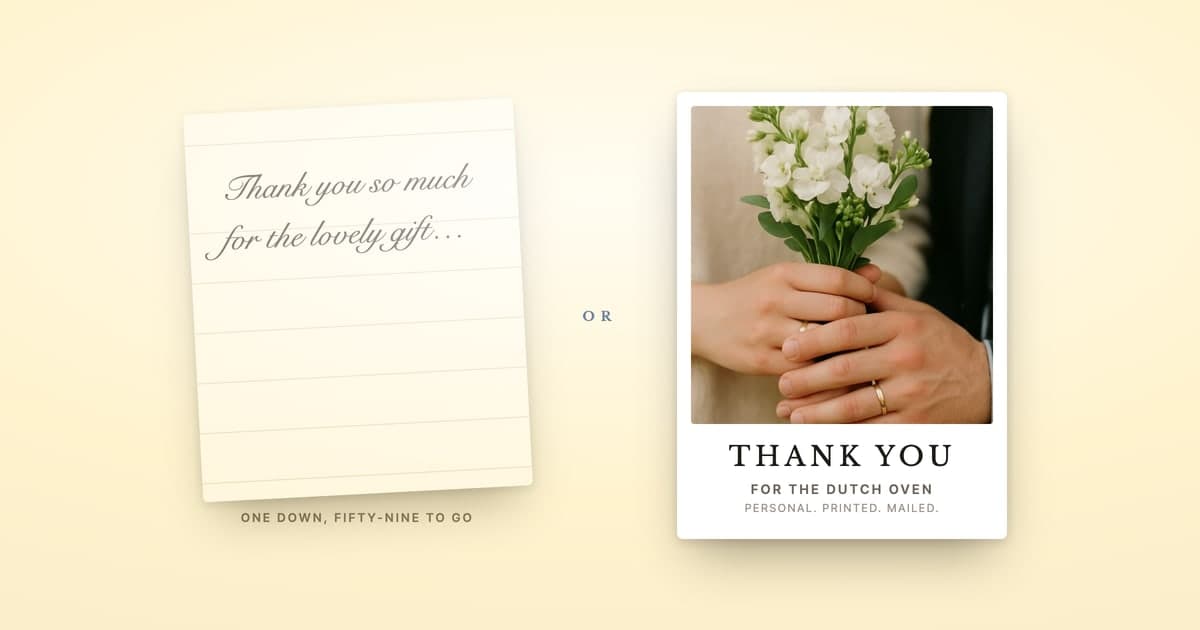
Sixty cards on the counter, one cramping hand, and a voice insisting that anything but ink is cheating.
No — thank-you cards do not have to be handwritten. Etiquette asks that a note be prompt, personal, specific, and mailed. Penmanship is the tradition, not the obligation — and the card that never gets written is the only real breach.
Below: what the rules require, what handwriting sixty cards really costs, and where the line falls.
What does etiquette actually require in a thank-you note?
Four things: that the note go out promptly, that it name the giver, that it name the specific gift, and that it arrive as a real piece of mail. Notice what is not on that list.
The traditional case deserves a fair hearing first. The Emily Post Institute's complete guide to writing thank-you notes is unambiguous about the format it prefers — handwritten is "always correct" and always appreciated, sent as soon as possible — and it is right about why. Ink is slow, and slowness is legible: your handwriting is evidence that you sat down and spent time on this person specifically, and no printer makes that signal. For a short list, handwritten is the better card, and nothing below argues otherwise.
But look at what the requirement is a requirement about. Every rule in the etiquette canon governs content and delivery: who you thank, for what, how soon, and by mail. Handwriting is the traditional vehicle for those things. It is not the cargo.
| What etiquette requires | Why it's the rule | Does handwriting change it? |
|---|---|---|
| Goes out promptly | The giver is waiting to know the gift landed | Yes — and usually for the worse |
| Names the giver | It proves the card was meant for them | No |
| Names the specific gift | It proves you know what they gave | No |
| Says something true about it | That's the part people remember | No |
| Arrives as physical mail | A card in hand is the acknowledgment | No |
Four of five rules are indifferent to how the words got onto the card. The one that isn't is the one handwriting makes harder.
Is it okay to type or print a thank-you note?
Yes — as long as every card carries a message written for the person opening it. The format etiquette genuinely rejects is the blank pre-printed card: "Thank you for your generous gift" already on the stock, your signature underneath, nothing else. That card tells the recipient they were processed.
The standard is personalization, not penmanship. A printed card that names your aunt and the stand mixer she picked out — and mentions the bread you made in it — carries more of her in it than flawless cursive reading "thank you for the lovely gift." The first proves you know what she gave you. The second proves you own a pen.
That standard survives being printed, which is the whole point: ShipNote prints, stamps and mails a card with its own message per recipient, so the personal part stays personal.
Do wedding thank-you cards need to be handwritten?
No — but weddings are where every other rule tightens. For wedding gifts, a physical card is still the standard, and an early text or email doesn't retire the obligation; guests barely register the digital one, and "we thanked everyone in the group chat" is what people actually notice. The Knot's guide to wedding thank-you notes and our full wedding etiquette rundown agree on the substance: every gift gets its own card, within about three months.
Weddings are also where handwriting fails most reliably. A hundred gifts, two people, three months, and both of you back at work — that is the batch that ends up half-finished in a drawer. Printing it is not the compromise it feels like at 11pm on a Tuesday; it is the version your guests actually receive. The complete wedding thank-you guide walks the whole sequence.
What does handwriting 60 cards actually cost you?
Three to six weeks of evenings, and roughly $2–$4 per card once you've bought the cards and put an 82¢ stamp on every envelope. Handwritten is not the free option — and the money is the smaller half of the bill. The calendar is where it actually costs you.
| Method | Realistic elapsed time | Cost per mailed card |
|---|---|---|
| Handwritten cards + envelopes + stamps | 3–6 weeks of sittings | ~$2–$4 (card + 82¢ stamp) |
| Photo cards printed, then hand-addressed + stamped | 1–2 weeks | ~$2.50–$4 |
| Registry paste + print-and-mail (ShipNote) | About 15 minutes of your time | $1.99 per card on 10+ |
Nobody insisting you must handwrite them prices that middle column. Three to six weeks is not a scheduling inconvenience — it is the mechanism by which cards go unsent: eight in the first sitting, four in the second, no addresses for a third of the list, and the pile moves to a shelf. (If yours has been there for months, it is not too late — late beats never.) That bottom row is one sitting with your laptop, not a project. Every method, timed and priced, is in the cheapest way to mail thank-you cards and the fastest way to send wedding thank-yous.
How do you make a printed card feel personal?
Name the giver, name the gift, and add one sentence only you could have written. That's it — three moves, and the third is what makes the card land.
Write one template with the two things that change, and the batch fills itself in:
"
[RECIPIENT]— thank you so much for the[GIFT_NAME]. It has been in constant use since the wedding, and we think of you every time."
Paste your purchased-gifts list from Amazon, Babylist, Zola, The Knot, Target, Crate & Barrel or Walmart and every card comes out with the right name and the right gift in it. Then go down the list and rewrite one line for the people who deserve a specific one — your aunt, your college roommate, the coworker who drove four hours. Twenty seconds each: twenty minutes of real writing across sixty cards, all of it spent on the part the recipient actually reads. Cards mail the next business day and arrive in 4–7 business days, which is the other thing a shelf of blank stationery cannot do. For wording, we keep five fill-in-the-blank templates by situation.
And a printed card holds one personalization lever a handwritten note never gets: the front. Make it a custom photo thank-you card — the wedding shot, the two of you mid-toast, the baby in the blanket she knitted — and it stops being stationery and becomes a photograph people keep. Ink proves you spent time; a photo of the moment proves you remember it. Use both sides for what they're best at: the photo does the feeling, the message does the naming. That lever does its best work at Christmas, where a photo of the kid in the sweater is the part grandparents actually keep — should you send thank-you cards for Christmas gifts sorts which gifts earn a card and which were already settled in the room.

Mailed next business day. $1.99 per card on 10+. No subscription.
When should you still handwrite?
When the batch is small enough that you will actually finish it, and when the writing itself is part of the gift. We print cards for a living and this is still true:
- Six cards, not sixty. A birthday, a small shower, a dinner party. You can finish six tonight, and handwritten is simply the nicer object.
- Your grandmother. Some people keep cards in a drawer and notice the ink. If you know one, write to them by hand — and print the other fifty-nine.
- A mentor, or anyone who did something large for you. A recommendation letter, an introduction that changed a job. That note is doing more than acknowledging a package, and it should look like it.
- When the note is the gift. If no object is involved and the words are the whole thing you're giving, handwrite them.
The dividing line is volume, not virtue. Six cards: pick up the pen. Sixty: print them, put a real line in every one, and get them in the mail this week — because the printed card that arrives beats the handwritten one that doesn't.
Related reading
- Wedding thank-you card etiquette — timing, cash gifts, group gifts, who gets a card.
- What to write in a wedding thank-you note — five fill-in-the-blank templates by situation.
- Is it too late to send wedding thank-you cards? — what each delay looks like from the other side of the mailbox.
- The fastest way to send wedding thank-yous — handwriting vs print-and-mail, start to mailbox.
- The cheapest way to mail thank-you cards — cards, stamps and services priced per mailed card.
- The complete wedding thank-you guide — the whole sequence, first draft to mailbox.
Ready to mail your thank-yous?
First batch ships next business day. From $1.99 per card. No subscription.
Create Your PostcardsCommon questions
No. Etiquette requires that a thank-you note be prompt, personal, specific about the gift, and mailed — handwriting is the tradition, not the requirement. A printed card that names the giver and what they gave beats elegant cursive that says only 'thank you for the lovely gift.' The card that never gets sent is the only real breach.
Yes, as long as the message was written for the person opening it. Typing or printing is fine when each card names the giver, names the specific gift, and adds a line only you could have written. The one format etiquette still rejects is the blank pre-printed card carrying nothing but a signature.
Not when they're personalized. What reads as tacky is the generic card — one manufactured sentence sent to eighty people with a name signed at the bottom. A printed card that mentions the stand mixer your aunt chose, and what you cooked in it first, reads as attention paid, not as a shortcut taken.
No, but the card itself is not optional. For wedding gifts, a physical card is still the standard, and an early text or email doesn't retire the obligation. Weddings are also where handwriting collapses most often — a hundred gifts, two people, three months — so a printed card with a personal message per guest is the version that actually gets mailed.
Not on its own for an occasion gift — a wedding, or anything that arrived by mail. A text is a good first acknowledgment that the package landed, and it buys you time, but the giver doesn't register it as the thank-you. For a small gift handed over and opened together, a warm thanks in the moment covers it. When in doubt, send the card.
Specificity, and actually sending it. Name the giver, name the gift, and say one true thing about it — that's the note the recipient remembers, in any format. A card that arrives with a real sentence in it outperforms a beautiful one still sitting on your counter three months later.