

How to Sign and End a Thank-You Card: 100 Sign-Offs
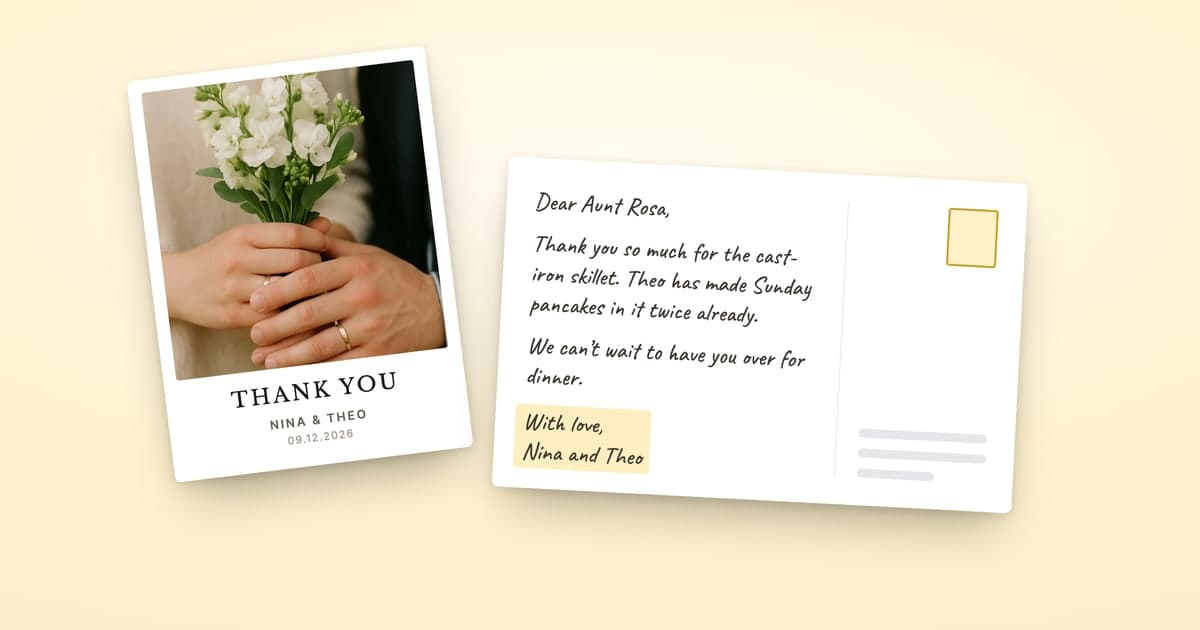
A thank-you card ends in three short pieces: a closing line, a sign-off word, and your name. Most people get stuck on the middle one, stare at "Sincerely" for a while, and then write "Thanks again!" and their first name. It doesn't take much to do better.
The quick answer: end with one sentence that looks ahead or says what the person means to you ("We can't wait to have you over"), then a sign-off that matches how close you are ("With love" for family, "Warmly" for friends, "With gratitude" or "Best regards" for work), then every name the gift was for. Couples sign both names, in either order. Families sign the adults, then the kids, or sign as "the Okafors."
Below: how to sign and end a thank-you card by how close you are, by occasion (wedding, baby shower, graduation, any gift) and by who is sending it (a couple, a family, parents-to-be, a business), plus a list of 100 sign-offs to copy.
Contents
- How do you sign a thank-you card?
- How do you end a thank-you note before the sign-off?
- Which sign-off fits which relationship?
- How to sign a wedding thank-you card
- How to sign a baby shower thank-you card
- How to sign a graduation thank-you card
- How to end a thank-you note for a gift
- How do couples sign a thank-you card?
- How does a family with kids sign a card?
- How should a business sign thank-you cards?
- Does the signature have to be handwritten?
- Which sign-offs should you avoid?
- 100 thank-you card sign-offs
- How the sign-off works on a ShipNote card
How do you sign a thank-you card?
Finish the message with a closing line, put a sign-off word or phrase on its own line followed by a comma, and sign every name the gift was meant for on the line below. That is the whole structure. The sign-off sets the tone, the closing line makes it personal, and the names tell the reader who is thanking them.
| Piece | What it does | Example |
|---|---|---|
| Closing line | Ends the message on the person, not the gift | We can't wait to have you over for dinner. |
| Sign-off | Sets the tone in one or two words | With love, |
| Names | Says who the thanks is from | Nina and Theo |
Put together, the last three lines of a wedding thank-you look like this:
We can't wait to have you over for dinner once the boxes are unpacked.
With love, Nina and Theo
Two small rules keep it clean. The sign-off takes a comma ("With love,") and the name goes on the next line, with no period after it. And the sign-off should agree with the greeting: a card that opens "Dear Mr. Patel" and closes "Hugs!" reads like two different people wrote it.
How do you end a thank-you note before the sign-off?
End on the person, not the gift. The last sentence before the sign-off should look forward ("See you at Thanksgiving") or say what they mean to you ("We're lucky to have you in our corner"), rather than only repeat the thanks. That sentence is what turns a correct note into one someone keeps.
Repeating the thanks is an accepted ending: the Emily Post Institute's guide suggests you "repeat the thanks or offer a concluding thought." A concluding thought does more work, because it could only have been written to this person. Some to borrow:
Looking ahead
- We can't wait to have you over for dinner once we're settled.
- See you at Thanksgiving. We'll save you a seat by the window.
- We hope to see you again before the year is out.
- Next time you're in town, the coffee is on us.
- We'll send photos once the baby arrives.
About them
- We're so lucky to have you in our corner.
- Having you there made the day feel complete.
- You always know exactly what we need, sometimes before we do.
- Your note made us both tear up, in the best way.
- Thank you for being the kind of friend who shows up.
About the gift in use (the strongest ending for a registry gift)
- Every time we use it, we'll think of you.
- It already has a permanent spot on the counter.
- The first pot of chili in it is yours if you visit.
- The baby's first bath will be wrapped in your towel.
- It's going with me to my first apartment.
For a formal or work note
- I look forward to working with you in the year ahead.
- Your guidance meant a great deal to me this year.
- Please give my best to your family.
One closing line is plenty. Two starts to sound like a speech.
Which sign-off fits which relationship?
Match the sign-off to how you would greet the person in real life. Family and close friends get "love"; friends, neighbors and coworkers you like get something warm without it; bosses, clients, teachers and anyone you'd call by a title get a formal closing. When you can't decide, "With gratitude" and "Warmly" fit almost anyone.
The Emily Post Institute's guide to writing thank-you notes sorts closings in much the same way: "Sincerely" for formal, professional and social notes; "Best regards", "All the best" and "Cordially" for professional and social ones; and "Yours truly", "Warmly", "Affectionately yours" and "With love" for social and personal ones.
| Closeness | Who | Sign-offs that fit |
|---|---|---|
| Warm | Parents, grandparents, siblings, best friends | With love, All our love, Love always, Hugs from both of us |
| Friendly | Friends, cousins, neighbors, coworkers you like | Warmly, With gratitude, Fondly, See you soon |
| Formal | Bosses, clients, teachers, parents' friends, anyone you'd call Mr. or Dr. | Sincerely, Best regards, With appreciation, Kind regards |
| Family-to-family | A household thanking another household | Love from all of us, With love from our house to yours |
For a batch of wedding or baby shower cards, most of the list sits in the first two rows. It's fine to use one sign-off for everyone in a row and change it only for the formal handful.
How to sign a wedding thank-you card
Sign a wedding thank-you with both of your first names under a warm sign-off, such as "With love, Nina and Theo," even when only one of you wrote it. Either name can go first. Add a surname only for guests who might not know you both, and leave "Mr. and Mrs." for the envelope, not the signature.
Wedding cards raise three questions the other occasions don't:
- Both names, every card. The gift was for both of you, so the thanks comes from both of you. It is fine to split the writing. The Emily Post Institute's thank-you FAQ says so directly: "For couples, it's perfectly fine to split up the notes for gifts you received together." Whoever writes a card signs both names.
- First names for almost everyone. Your guests know who you are. "Nina and Theo" is warmer than "Nina and Theo Alvarez," and it sidesteps the name-change question entirely. Use surnames for your parents' friends, your partner's coworkers, or anyone who met only one of you.
- Cards for shower or early gifts. Thank-yous for gifts that arrive before the wedding go out under the names you have now. Emily Post's wedding thank-you advice applies the same logic to stationery: "Monogrammed stationery should reflect your current name, so wait to use your married monogram until after the wedding."
Wedding sign-offs
| For family and close friends | For everyone else |
|---|---|
| With love, Nina and Theo | With gratitude, Nina and Theo |
| All our love, Nina and Theo | Warmly, Nina and Theo |
| Love from the newlyweds, Nina and Theo | With many thanks, Nina and Theo Alvarez |
| Love from both of us, Nina and Theo | Best regards, Nina and Theo Alvarez |
Closing lines for a wedding card
- Having you there made the day feel complete.
- We can't wait to host you in our new place.
- Every time we use it, we'll think of our wedding day.
- Thank you for traveling so far to celebrate with us.
- We're so glad you were part of our day, and we hope to see you soon.
If you're working out the rest of the message, our wedding thank-you templates cover cash gifts, group gifts and guests who couldn't come, and the wedding thank-you etiquette guide covers timing.
How to sign a baby shower thank-you card
Sign a baby shower thank-you from both parents-to-be, and add the baby only if you want to: "Love, Ana, Luis and Baby Rivera" before the birth, or "Love, Ana, Luis and Mateo" once the baby is here and named. If you're keeping the name a secret, "and the bump" or "and Baby Rivera" works without giving it away.
A few details make these cards feel right:
- Both parents sign when the gift was for the baby, even if one of you did all the writing.
- The baby's name is optional. Some parents love signing for the baby; others find it cute for grandparents and a bit much for coworkers. Sign for the baby on the family cards and skip it on the others if you like.
- A single parent signs alone, or with the baby. "With love, Jess and Baby Rivera" is complete as it is.
- Late thank-yous after the birth are a natural place to use the baby's name and a photo. Nobody minds a card that arrives with a newborn on the front.
Baby shower sign-offs
| Before the birth | After the birth |
|---|---|
| With love, Ana, Luis and Baby Rivera | Love, Ana, Luis and Mateo |
| Love from the parents-to-be, Ana and Luis | With tiny hugs, Mateo (and Ana and Luis) |
| All our love, Ana, Luis and the bump | Sleepily but gratefully, the Riveras |
| With love from our growing family, Ana and Luis | Love from the three of us, Ana, Luis and Mateo |
Closing lines for a baby shower card
- We'll send photos once the baby arrives.
- The baby's first bath will be wrapped in your towel.
- We can't wait for you to meet the newest Rivera.
- Thank you for making us feel so ready.
For the message itself, we keep full baby shower thank-you wording by guest type, including hosts, group gifts and guests who sent a gift but couldn't come.
How to sign a graduation thank-you card
The graduate signs a graduation thank-you card, alone, with the name the reader knows: a first name for family, and a first and last name for teachers, mentors, and parents' friends who might know several graduates. A warm, slightly forward-looking sign-off fits the moment: "With gratitude," "Thanks for cheering me on," or "Onward, and thank you."
- The graduate writes and signs it. Parents can nudge, address and mail, but the thanks should come from the person who got the gift.
- Use your full name for anyone outside the family. A teacher with a class of thirty, or a neighbor who knows you as "the Chen kid," will be glad of it.
- Say what's next. Graduation is the one thank-you where the closing line is expected to be about you: the school, the job, the move.
Graduation sign-offs
- With gratitude, Maya
- Thanks for cheering me on, Maya
- Onward, and thank you, Maya Chen
- Proud and grateful, Maya
- With love, your favorite graduate, Maya
Closing lines for a graduation card
- I'll put it to good use in my first apartment.
- I couldn't have gotten here without people like you in my corner.
- I'll send an update once I've started at State in the fall.
- Thank you for believing in me long before I had a diploma to show for it.
How to end a thank-you note for a gift
End a gift thank-you by saying how the gift will be used or where it lives now, then a sign-off and your name. "It already has a permanent spot on the counter. With love, Nina" tells the giver their choice landed, which is what they want to know, and only this gift could get it.
The pattern works for any gift, any occasion:
| Gift | Closing line | Sign-off |
|---|---|---|
| A kitchen gift | The first pot of chili in it is yours if you visit. | With love, |
| A gift card | We're saving it for a date night once things calm down. | Warmly, |
| Cash | It's going straight into our fund for the new couch, and we'll think of you every time we sit on it. | With gratitude, |
| A handmade gift | We'll treasure it, and so will the baby. | All our love, |
| A book | I've already read the first three chapters. | Thanks for thinking of me, |
| A group gift (one card per household) | Every time we use it, we'll think of all of you who chipped in. | With love, |
When one gift came to your whole household, the Emily Post Institute's FAQ says a group note is acceptable: "just ask each recipient to sign." The reverse case is a group gift. When several households chipped in for one present, send one card to each household, and name the gift in every card. For an office or team gift, one card to the team covers it.
How do couples sign a thank-you card?
Sign as a couple with both first names joined by "and": "Nina and Theo." Either name can go first; put first whichever name the reader knows best if you want a tiebreaker. Keep titles off the signature, add surnames only for people who might not know you both, and sign both names even when one of you wrote the card.
Whose name goes first? Nobody's, by rule. In its advice on holiday cards, the Emily Post Institute says it "does NOT matter what order you put the names in" and that couples "do not have to abide by either ladies first or gentleman first." We'd apply the same to a thank-you. The tiebreaker we'd use is the reader: your aunt reads your name first, your partner's college roommate reads theirs.
Mr. and Mrs.? Keep titles for the envelope. A card signed "Mr. and Mrs. Theo Alvarez" reads like a return-address label, and it drops one of your first names entirely. The playful version works for friends as a line on its own, as long as your names follow it:
Love from the new Mr. and Mrs., Nina and Theo
Different last names, or a name change in progress? First names solve both. When a surname is needed, write both in full: "Nina Brooks and Theo Alvarez."
One partner's side of the family? Still sign both names. The gift was for both of you. If a relative barely knows your partner, put your own name first.
How does a family with kids sign a card?
Sign as a family by listing the adults, then the children, or by signing with the family name: "Love, the Okafors" or "With love, the Okafor family." Adults first, then the kids from oldest to youngest, is the usual order.
The Emily Post Institute's holiday card advice says most people put the adults first and the kids afterward, adds that "even this is not a hard and fast rule at all," and says pets can be added as well.
- Plural, not possessive. "The Okafors" and "the Okafor family" are both right. "The Okafor's" is not: the apostrophe makes it possessive. For a name ending in s, add -es: "the Harrises," "the Joneses."
- Let the kids sign. A child old enough to write their own name can add it. Their wobbly signature is the part grandparents keep.
- Switch to the family name past four or five names. A long list crowds a small card, and a postcard back especially.
- Pets go last, if they go at all.
Family sign-offs
- Love, Emeka, Grace, Tobi and Ada
- With love, the Okafors
- Love from all of us, the Okafors
- With love from our house to yours, the Okafor family
- Hugs from all four of us (and the dog), Emeka, Grace, Tobi and Ada
How should a business sign thank-you cards?
A business thank-you is signed by a person, not a logo: a sign-off, your name, and the company on the line below. "With thanks, Dana Reyes, Reyes Home Group" reads like a note from someone; "Sincerely, The Reyes Home Group Team" reads like a statement.
If a whole team is thanking a client, the person who knows them best signs first, and "and the team at Reyes Home Group" follows.
Business sign-offs
- With thanks, Dana Reyes, Reyes Home Group
- Gratefully, Dana
- Thank you for your trust, Dana and the Reyes Home Group team
- Warm regards, Dana Reyes
- With appreciation, Dana Reyes, Broker
Business senders tend to mail to a whole client list at once. ShipNote does business thank-you cards for exactly that.
Does the signature have to be handwritten?
No. A printed sign-off is fine when the message above it was written for the person reading it: it names them, names what they gave, and says one true thing about it. What reads as careless is the generic card, the same sentence to everyone with a name at the bottom, and a pen signature doesn't rescue that card.
The traditional view is stricter. The Emily Post Institute's wedding thank-you advice says "there is nothing more appreciated than a lovely handwritten thank-you note" and rules out pre-printed cards. Handwriting is still lovely for a short list, and nothing is wrong with printing a message and adding your signature in ink. But for a batch of 60 wedding thank-yous, the real risk isn't a printed signature. It's the card that never goes out. We make the full case in do thank-you cards have to be handwritten.
If you print your cards, two things keep a printed signature feeling personal: sign with the names the reader calls you, and make the closing line specific to them.
Which sign-offs should you avoid?
Most sign-off mistakes are a mismatch between tone and relationship, or a missing name. Skip these:
- "Sincerely" to your grandmother. It's correct and it's cold. Save it for formal notes.
- "Love" to your boss. Right sentiment, wrong relationship.
- "Thanks again!" as the whole ending. It's allowed, but it's a missed chance. Put one line about the person before it.
- "Best," on its own, on a personal card. It's fine in a work note but reads like an email to family. "All the best" or "Best wishes" is warmer.
- One name on a joint gift. If the gift was for both of you, both names go on the card.
- "The Okafor's." An apostrophe makes it possessive. The family is "the Okafors."
- A sign-off that fights the greeting. "Dear Dr. Lin" and "XOXO" don't belong on the same card.
- No name at all. A pre-printed card with nothing added is the card that reads as careless, whatever else is on it.
100 thank-you card sign-offs
Pick the group that matches how close you are, then add your names on the line below. Every sign-off here takes a comma after it.
Warm and loving (family and close friends)
- With love
- All our love
- Love always
- Lots of love
- With all our love and thanks
- Love and hugs
- Much love
- Love you lots
- With a full heart
- With heartfelt love
- Love from both of us
- Love from all of us
- Sending love
- With love and gratitude
- Love and thanks
- Big hugs
- With so much love
- Yours, with love
- All my love
- Love, now and always
Grateful (any thank-you)
- With thanks
- With gratitude
- With deep gratitude
- Gratefully
- Gratefully yours
- With heartfelt thanks
- Many thanks
- With sincere thanks
- Thankfully yours
- With appreciation
- With warm appreciation
- In gratitude
- Forever grateful
- So grateful
- Endlessly grateful
- With thanks and love
- Grateful for you
- With a thankful heart
- Thank you for thinking of us
- With our warmest thanks
Friendly (friends, neighbors, coworkers you like)
- Warmly
- Warm wishes
- Cheers
- Take care
- See you soon
- Until next time
- Talk soon
- All the best
- Best wishes
- Fondly
- Your friend
- Hugs
- Can't wait to see you
- Yours truly
- Affectionately
Formal and professional (bosses, clients, teachers)
- Sincerely
- Sincerely yours
- Best regards
- Kind regards
- Warm regards
- Respectfully
- Cordially
- With sincere appreciation
- With respect
- Regards
- With many thanks
- Thank you for your trust
- With thanks for your support
- Respectfully yours
- With gratitude and best wishes
Wedding
- Love from the newlyweds
- With love from the two of us
- All our love, now and always
- With love and so much gratitude
- Happily married and grateful
- From our new home to yours
- With love from the happy couple
- Love from the new Mr. and Mrs.
- Cheers to many more years
- Happily ever grateful
Baby shower and new parents
- Love from the parents-to-be
- With love from our growing family
- Love from the three of us
- With tiny hugs
- Sleepily but gratefully
- With love from the nursery
- Love from us and the bump
- With love from Baby and us
- Love and snuggles
- From our little family to yours
Graduation
- Thanks for cheering me on
- Proud and grateful
- Onward, and thank you
- With thanks for getting me here
- From the graduate
- To the next chapter
- Diploma in hand and grateful
- With gratitude and big plans
- Thank you for believing in me
- From one proud graduate
How the sign-off works on a ShipNote card
ShipNote prints thank-you postcards from your guest list and mails them for you. On a ShipNote card, the sign-off is part of the printed message on the back: you write one message for your whole list, and every card prints with the same ending unless you change one.
The message uses two placeholders: [RECIPIENT] becomes each guest's name and [GIFT_NAME] becomes the gift they gave. Then you paste your registry list (or a spreadsheet, or notes), and ShipNote reads each guest's name, their gift and, where the list has one, their mailing address. So one card opens "Dear Rosa Diaz," and thanks her for the skillet, and the next names a different guest and gift.
The sign-off sits at the end of that message. Every occasion's starting message ends with a closing and a [YOUR NAME] placeholder: "Best regards," on the wedding card, "With love," on the baby shower card, "With gratitude," on the graduation card and "With thanks," on Just Thanks. When you type your name into your return address, ShipNote fills [YOUR NAME] with it. From then on the ending is yours to edit, so "Best regards, Nina Brooks" can become "With love, Nina and Theo." A card can't reach checkout with [YOUR NAME] still in it, so nobody receives a card signed with a placeholder.
The message, sign-off included, prints in the font you pick for the back: Serif, Modern, Handwritten, Script or Elegant. Handwritten and Script are the closest to a pen signature. On the review step you can open any single card and change its ending, so Grandma's card can say "Love you, Grandma. See you at Thanksgiving" while the rest of the list keeps the shared closing.
Your message, with the ending made warmer, might look like this:
Dear [RECIPIENT],
Thank you so much for the [GIFT_NAME]. Every time we use it, we'll think of you, and we can't wait to have you over once we're settled.
With love, Nina and Theo
ShipNote cards are $1.99 a card on 10 or more, printed, sent with USPS First-Class postage and mailed for you. That is the job ShipNote is built for: a registry list of 20 to 100 guests.
Start your wedding thank-yous, start your baby shower thank-yous, or start your graduation thank-yous. Or see how ShipNote works first.
Related reading
- What to write in a wedding thank-you note: five templates and example messages for every kind of wedding gift.
- Wedding thank-you note etiquette: who writes, how soon, and the tricky cases.
- Baby shower thank-you wording: messages for guests, hosts and group gifts.
- Do thank-you cards have to be handwritten?: the real rule, and when printing is the better card.
- Thank-you note generator: a free starting draft you can personalize.
Ready to mail your thank-yous?
First batch ships next business day. From $1.99 per card. No subscription.
Create Your PostcardsCommon questions
Either one. Emily Post's advice on holiday cards says the order of names does not matter, and we'd apply the same to a thank-you. A useful habit is to put first the name the recipient knows best, so your aunt reads your name first and your partner's college roommate reads theirs. What matters is that both names are on every card for a gift you received together.
Not as your signature. Titles belong on the envelope, and a card signed Mr. and Mrs. Alvarez reads like a return-address label. Sign with first names, adding a surname only for guests who might not know you both. A playful line such as 'from the new Mr. and Mrs.' is fine for friends, as long as your names follow it.
One sentence that looks forward or says what the person means to you, placed just before the sign-off. For example: We can't wait to have you over for dinner, or We're so lucky to have you in our corner. Repeating the thanks is fine too, but a line about the person makes the ending feel written for them.
It is correct, but it is the formal choice. Use Sincerely for a boss, a client, a teacher or anyone you would address by title. For family and friends it reads cold. Choose With love, Warmly, With gratitude or With thanks instead.
No. A printed signature is fine when the message above it was written for the person reading it: their name, the gift they gave and a line about it. What reads as careless is a generic card with nothing personal on it, whether the name at the bottom is inked or printed.
List the adults and then the children, or sign as the family: Love, the Okafors, or With love, the Okafor family. Never write the Okafor's, which is a possessive, not a plural. Children who can write can add their own names, and a pet can go last if that is your family's style.