ShipNote Order Data: How Many Cards People Send at Once
ShipNote prints, stamps and mails postcards from a guest list, from thank-you cards to save-the-dates, so every order leaves a record of how people actually send them: how many cards at once, for which occasion, and how much they write card by card. These are the aggregate figures from our paid customer orders.
Contents
- The figures
- What the figures mean if you have cards to send
- Methodology
- How to cite this data
- Frequently asked questions
The figures
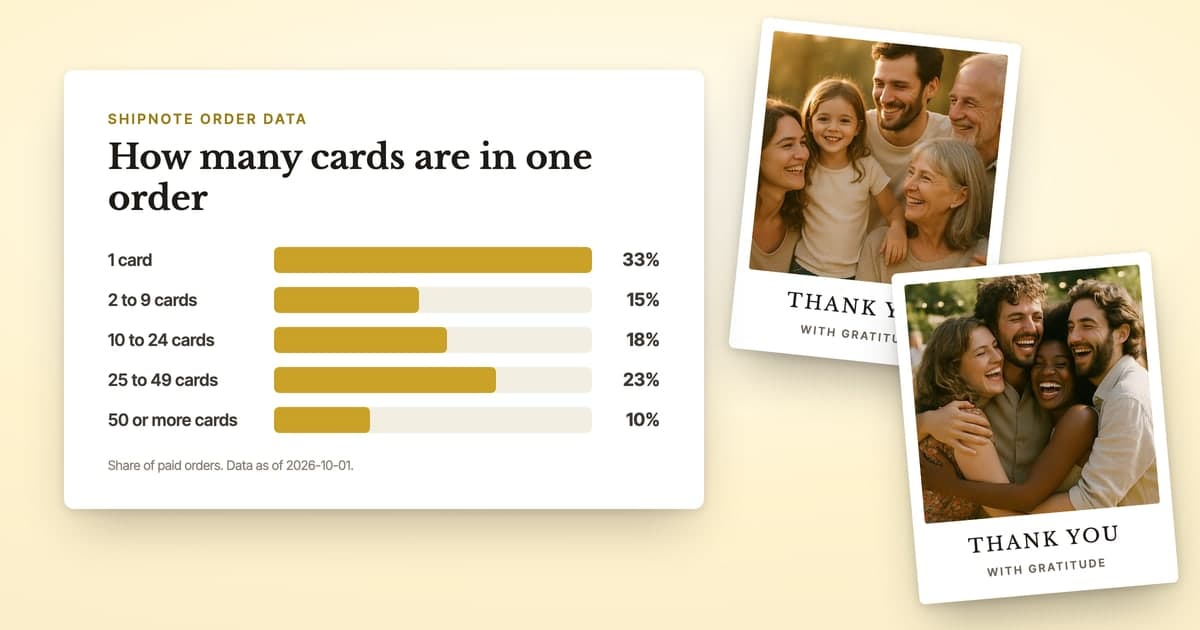
Data as of 2026-10-01.
Cards per order
- Median order: 10 cards.
- 95% of all cards were in orders of 10 or more.
| Order size | Share of orders |
|---|---|
| 1 card | 33% |
| 2 to 9 cards | 15% |
| 10 to 24 cards | 18% |
| 25 to 49 cards | 23% |
| 50 or more cards | 10% |
Occasion
| Occasion picked | Share of orders |
|---|---|
| Just Thanks | 44% |
| Baby Shower | 25% |
| Save the Date | 9% |
| Other occasions | 22% |
Cards edited one by one
- In 60% of orders of two or more cards, the sender edited at least one card's message individually rather than sending every card as the order's shared message.
Cards that name the gift
- In 48% of orders of two or more cards, at least one card named the guest's gift in its printed message.
What the figures mean if you have cards to send
Cards are a batch job. Many orders are a single card, but the cards themselves mostly go out in lists of ten, twenty-five or fifty at a time: a whole guest list, sent in one sitting. If your list is long, you are the typical sender, not the exception. Our guide to sending the cards you can when some addresses are missing covers a common snag in a batch that size.
A batch is not a form letter. In 60% of orders of two or more cards, at least one card's message was edited individually. The approach that works is one message for the whole list with each guest's name and gift filled in, then a personal line for the people who need more than that: a grandparent, the friend who flew in, the person whose gift you use every day. We make the case for it in do thank-you cards have to be handwritten?
Name the gift when you have it. Registry lists carry the gift beside each guest, so a card can say exactly what it is thanking them for.
If you have a list to send, start on the ShipNote homepage: write one message, paste the registry, edit the cards that need it, and every card is printed, stamped and mailed for you.
Methodology
- Source. ShipNote's production order records, read with a read-only script that we re-run to update the study. Every figure in the tables and bullets above is printed by that script and published exactly as it prints it.
- Which orders count. Paid orders whose send has finished (status sent or partially sent). Unpaid drafts, orders refunded in full, orders still sending, test orders and the founder's own orders (matched by email, or by name and city) are excluded.
- All occasions. The order-size figures cover every occasion, so they include save-the-dates and other non-thank-you cards; the occasion table shows the mix.
- The floor. A figure drawn from too few orders to keep any customer unidentifiable is not published. An occasion picked on fewer than three orders is folded into "Other occasions", so no row describes one or two customers.
- Occasion is the design category the sender picked in ShipNote (for example Just Thanks, Baby Shower or Save the Date), not a record of the event itself. It is recorded only on more recent orders, so that figure covers fewer orders than the others.
- Orders of two or more cards. Most single cards are written in a one-step flow that records neither a per-card edit nor a gift, so the two per-card figures are measured only on orders of two or more cards, placed after ShipNote began printing every card from one shared message plus that card's own edits.
- Edited individually means the sender typed a change into that card's message on the review step, where each card can be edited on its own; any change counts, however small. Orders placed before ShipNote began recording this are left out.
- Names the gift means the card's printed message contains the gift recorded for that guest: the shared message carries the gift placeholder, or an edited card's own text includes the gift's name.
- Reading the shares. Read them as the shape of real orders, not as precise population estimates. We re-run the study periodically.
- Privacy. Only shares and medians are published. No name, address, message, email, gift or order is shown or can be derived from these tables.
How to cite this data
You are welcome to quote these figures. Please cite ShipNote order data and link to this page, and include the date the data was drawn, shown at the top of the figures. If you need a figure we have not published, or a fresh run, contact us.
Frequently asked questions
How many cards are in a typical ShipNote order?
The median order is 10 cards. 33% of orders are a single card, yet 95% of all cards were in orders of 10 or more.
Do people personalize cards they send in bulk?
Many do. In 60% of ShipNote orders of two or more cards, the sender edited at least one card's message individually rather than sending every card as the order's shared message.
Where does this data come from?
From ShipNote's own order records: every paid customer order whose send has finished, with test orders and the founder's own orders removed. Only shares and medians are published, never a name, address, message or order, and any figure drawn from too few orders to keep customers unidentifiable is left out.
Ready to mail your thank-yous?
First batch ships next business day. From $1.99 per card. No subscription.
Create Your Postcards