
How to Send Donor Thank-You Cards to Your Whole List
A nonprofit's thank-you list usually already exists. It's the export from the donor database, the spreadsheet from the auction, or the column of names the PTA treasurer kept during the fundraiser. The hard part isn't knowing what to say. It's turning 60 names into 60 addressed, stamped cards before the gift feels old.
To send donor thank-you cards to your whole list, write one message with a name placeholder, upload the list you already have, and have each donor's card printed with their name, addressed and mailed for you. On ShipNote that takes one sitting, and postage is included.
This guide walks through that batch step by step, shows how the same steps work for volunteers and sponsors, then covers when to send, what to put on a postcard (and what to leave off), and whether the card can be the donor's tax receipt.
Contents
- How to mail thank-you cards to every donor on your list
- Volunteers and sponsors: same list, same steps
- When to send donor thank-you cards
- What to put on the card, and what to leave off
- Is a thank-you card a tax receipt?
How to mail thank-you cards to every donor on your list
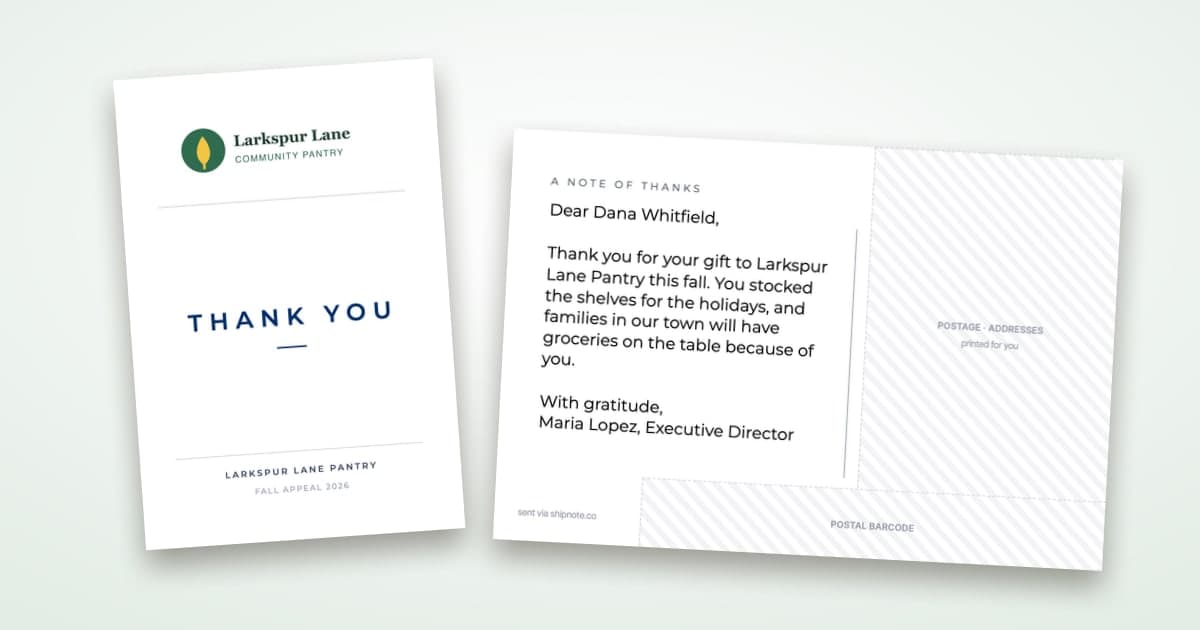
ShipNote prints a thank-you postcard for every donor on your list, addresses it, adds USPS First-Class postage and mails it for you. It's the same flow as our business thank-you cards, which is built for mailing a whole list at once, and it works the same for a nonprofit, a PTA or a church: you write one message, upload the list you already have, and each card prints with that donor's name. Because the flow is built for businesses, its screens call your donors clients. Here is the flow, run with a four-donor spreadsheet.
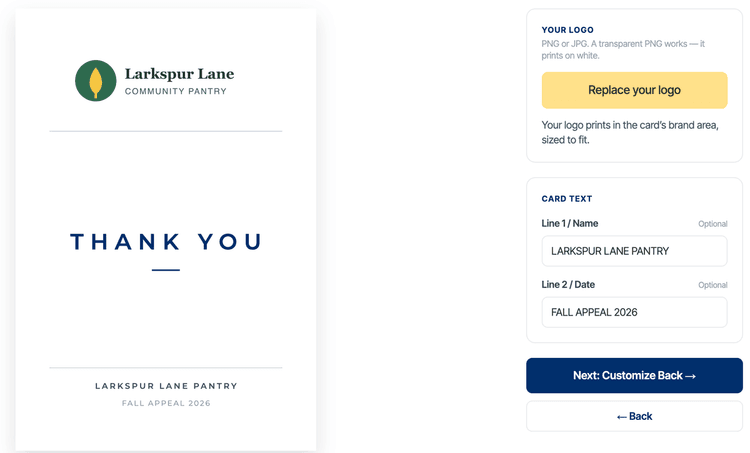
1. Pick a logo card and add your logo. Letterhead, Crest, Column, Stamp and Navy each print your logo with a thank-you headline, plus two short lines you type, such as your organization's name and the campaign. Skip Masthead for donors: it prints "For your business" under the thank-you. To use your own artwork instead, pick the Blank card; it prints edge to edge with no ShipNote branding on the front.
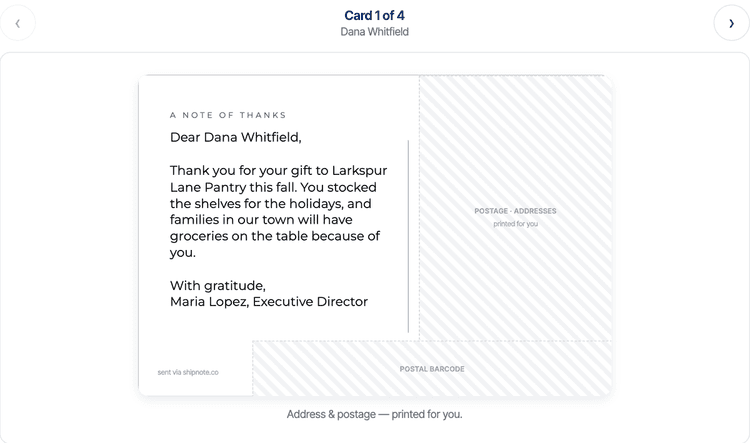
2. Write one message for everyone. Replace the starter note with your own. The placeholder is [CLIENT], and it prints each donor's name as your list gives it. The message on the cards below:
Dear [CLIENT],
Thank you for your gift to Larkspur Lane Pantry this fall. You stocked the shelves for the holidays, and families in our town will have groceries on the table because of you.
With gratitude, Maria Lopez, Executive Director
3. Upload the donor list you already have. Export a CSV or Excel file from your donor database or fundraising platform, or use the spreadsheet you kept, and upload it. There's no column mapping and no import format to match. ShipNote uses only each donor's name and mailing address, and the gift amounts, emails and notes in the file are ignored, so you don't have to clean the export first. Every address is checked against USPS records.
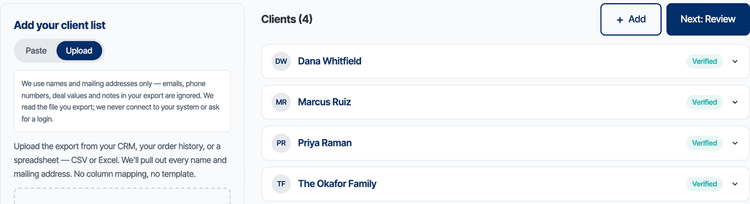
Online donors often leave an email and no mailing address. Those rows still load. When you press Next: Review, any donor without an address is flagged, and that row offers Don't have their address? Request it with a link, which you can send to the donor so they type in their own address.
4. Review every card, and add a line for the donors who deserve one. Each donor gets their own card. Flip through them, check the greeting reads the way you want (the list above printed "Dear Dana Whitfield," and "Dear Okafor Family,"), and tap into any single card to change it to "Dear Dana," or add a sentence for a major donor or an in-kind gift without touching the rest.
5. Check out. Each card costs $2.49, or $1.99 each from 10 cards, with printing, postage and mailing included, so a 50-donor mailing comes to $99.50. There's no account, no subscription and no minimum, and the order confirmation email carries a receipt with the order number, date, total and payment method for your bookkeeper.
Write one message, upload your donor list, and every card is printed, addressed and mailed for you.
Volunteers and sponsors: same list, same steps
The batch doesn't care whether the list is donors. Change the message, then upload the volunteer roster after the gala or the sponsor list after the 5K:
- Volunteers: thank them for what they did, in their terms. "Thank you for every Saturday you spent sorting donations this year. You helped us serve more families than ever."
- Sponsors: name the event and what the sponsorship paid for. "Thank you for sponsoring the spring gala. Your support covered the evening's costs, so every dollar raised in the room went to the program."
If a sponsor needs a formal letter for their records, send it on letterhead with the figures. The card goes first as the personal thank-you.
When to send donor thank-you cards
Send donor thank-you cards within days of the gift, not at the end of the quarter. A common fundraising practice is to thank a donor within 48 hours and within a week at most, and a mailed card takes a few days in transit, so finish the list soon after the gift or the event.
On ShipNote, cards are usually printed and mailed with USPS First-Class postage the next business day, and they typically arrive in 4–7 business days. A list finished the Monday after a Saturday gala usually goes in the mail on Tuesday.
You can also pick the mail date. At checkout, choose "On a date I choose" and any weekday up to 90 days out, and every card is held until then. That lets you finish a Giving Tuesday or year-end list while it's in front of you and have the cards land when you want them to. You can cancel for a full refund until noon ET the business day before.
For a year-end campaign, send cards in batches as the gifts come in rather than one big mailing in January. A gift made on December 29 deserves a card in the first week of January, not in March.
What to put on the card, and what to leave off
A donor card has four parts: the donor's name, a thank-you for the gift, one sentence about what the gift did, and a signature from a real person. The one sentence is the part donors remember. "Thank you for your generous support" could go to anyone; "your gift stocked the pantry for the week before Thanksgiving" tells them where their money went. Don't add a new ask: a thank-you with an ask in it reads as an appeal.
| Put it on the card | Leave it off the card |
|---|---|
| The donor's name | The gift amount |
| The campaign or program the gift went to | A request for another gift |
| One specific result | Tax language and receipt details |
| A real person's signature | The donor's giving history |
| A line about what happens next (optional) | Anything private about the people you serve |
Why leave the amount off? A postcard has no envelope, so anyone who handles the mail can read the back. "Thank you for your gift to the fall appeal" says everything the donor needs; the number belongs in their acknowledgment. The same goes for a major gift: "the largest gift we've ever received" tells every mail handler the donor gave a lot. Say that in a sealed letter or in person. On the card, add a personal line for that donor on the Review step, not the size of the gift.
Protect the people you serve, too. "A family of five had groceries for the week" is a result. A name, a photo or a detail that identifies a client is not something to print on mail.
Is a thank-you card a tax receipt?
Usually not. For any single gift of $250 or more, the IRS says a donor can't claim the deduction without a written acknowledgment from the charity that gives the organization's name, the amount of a cash gift (or a description, not the value, of donated property), and a statement of whether the organization provided any goods or services in return. If it did, such as a gala dinner, the acknowledgment describes them and gives a good-faith estimate of their value; a church whose only benefits to the donor were intangible religious ones can say so. Separately, a payment over $75 that is partly a gift and partly buys something, such as a gala seat, needs a written disclosure statement from the charity. That's from IRS Publication 1771, and the IRS written acknowledgments page lists these contents too.
Publication 1771 says letters, postcards and computer-generated forms carrying that information are all acceptable, so a card could serve as one. But a warm thank-you card isn't written to carry an amount and a goods-and-services statement, and a postcard shows whatever is printed on it to anyone who handles the mail. The simpler split is the one most organizations already use: send the formal acknowledgment by letter, email or a year-end summary, and send the thank-you card to say thank you. Publication 1771 notes that charities typically send written acknowledgments no later than January 31 of the year after the gift.
This is a summary, not tax advice. If your organization isn't sure what its acknowledgments need to say, check Publication 1771 or ask your accountant.
Related reading
- Thank-you cards from a CRM export: how the upload reads a file straight out of your database.
- Amazon wish list thank-you notes: for classroom and shelter wish lists, where donors are strangers.
Ready to mail your thank-yous?
First batch ships next business day. From $1.99 per card. No subscription.
Create Your PostcardsCommon questions
Pick a card with your logo, write one message with a name placeholder, then upload the donor list exported from your database or fundraising platform, or the spreadsheet you kept. Every donor gets their own printed card, addressed and mailed with First-Class postage. There's no column mapping, and gift amounts, emails and notes in the file are ignored.
On a postcard, leave it off. Anyone who handles the mail can read the back of a postcard. Name the campaign or what the gift paid for instead, and put the amount in the donor's formal acknowledgment, sent as a letter, an email or a year-end summary.
Not unless it carries what the IRS asks for. For a single gift of $250 or more, the donor needs a written acknowledgment that gives the organization's name, the amount (or a description of donated property), and whether anything was given in return, with a description and estimated value if something was. A card that just says thank you doesn't do that, so send the formal acknowledgment separately.
Yes. Change the message to thank them for their hours or their sponsorship, then upload the volunteer roster or the sponsor list instead of the donor list, and each person's card prints with their name and mails the same way.