
Do People Still Send Thank-You Cards? Stats by Generation
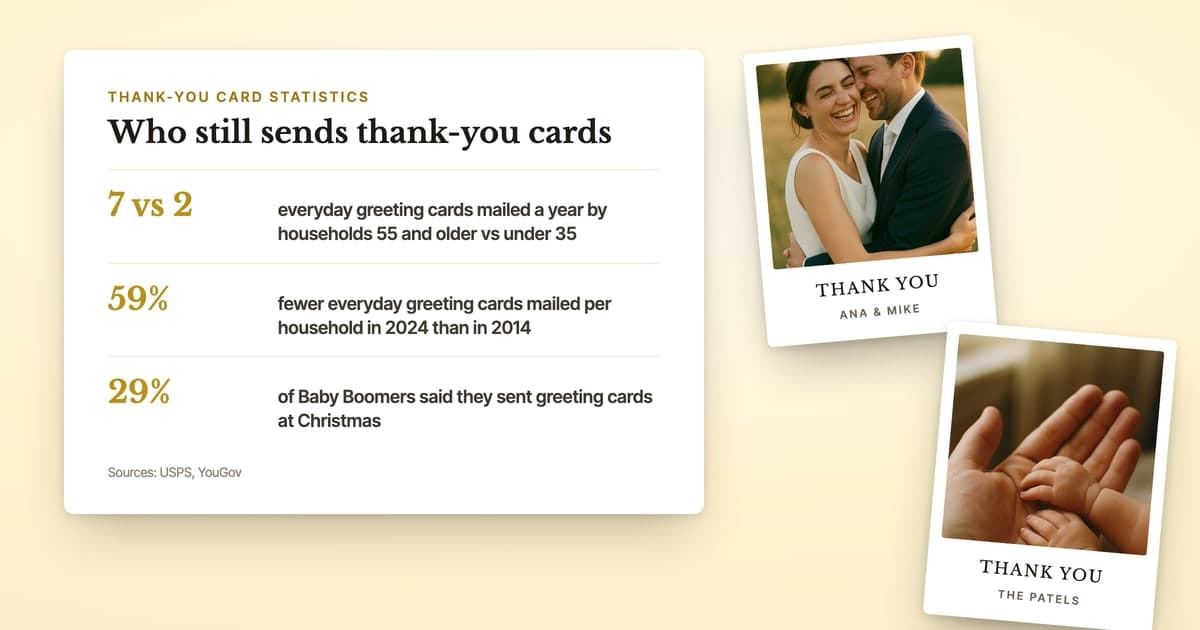
Yes, but mostly older Americans, and fewer every year. In 2023, households headed by someone 55 or older mailed 7 everyday greeting cards, against 2 for households headed by someone under 35. On a separate USPS count, everyday cards mailed per household fell from 11.6 in 2014 to 4.7 in 2024.
Everyday greeting cards are non-holiday greeting cards: birthday, sympathy, thank-you and other occasion cards. US Postal Service mail studies count thank-you cards in this group, not on their own.
Every figure was checked against its source in October 2026. Sources are listed at the end of each section and in full at the end of this page.
Contents
- Key thank-you card statistics
- Younger vs older at a glance
- Do people still send thank-you cards?
- Which age group sends the most cards?
- How much does each generation spend on postage?
- Do younger people expect a thank-you note?
- Do younger people prefer digital thank-you notes?
- Do people send thank-you notes after a job interview?
- Do people value handwritten notes?
- How much does it cost to mail thank-you cards?
- Sources and how to cite this page
- Frequently asked questions
Key thank-you card statistics
- 7 vs 2 everyday greeting cards mailed a year by households 55 and older vs under 35 (2023).
- 59% fewer everyday greeting cards mailed per household in 2024 than in 2014.
- 29% of Baby Boomers said they sent greeting cards at Christmas, against 13% of Gen Z (2024–25 survey).
- 78% of adults over 60 would be hurt to get no thank-you note for a wedding gift; 64% of adults 18 to 29 would not be (2016).
- 35% of adults 18 to 29 prefer to send a physical thank-you note, against 30% who prefer a digital one (2023).
- $63 a year on postage for Baby Boomer households, against $29 for Millennial households (2024).
- 9% of Americans say a job applicant should be expected to send a handwritten thank-you note (2022).
Sources: USPS, YouGov 2025 and 2022, FiveThirtyEight, BLS
Younger vs older at a glance
Older Americans come out ahead on every measure here.
| Measure | Younger | Older |
|---|---|---|
| Everyday greeting cards mailed per household (2023) | Under 35: 2 | 55 or older: 7 |
| Cards, letters and forms mailed per household (2024) | 18 to 34: 3.8 | 55 or older: 22.1 |
| Sent greeting cards at Christmas (2024–25 survey) | Gen Z: 13% | Baby Boomers: 29% |
| Spent on postage per household (2024) | Millennials: $29 | Baby Boomers: $63 |
| Would be hurt by no wedding thank-you note (2016) | 18 to 29: 36% | Over 60: 78% |
| Prefer to send a physical thank-you note (2023) | 18 to 29: 35% | 65 and over: 47% |
| Say a handwritten note makes a gift stand out (2016) | 18 to 34: 53% | 55 and over: 67% |
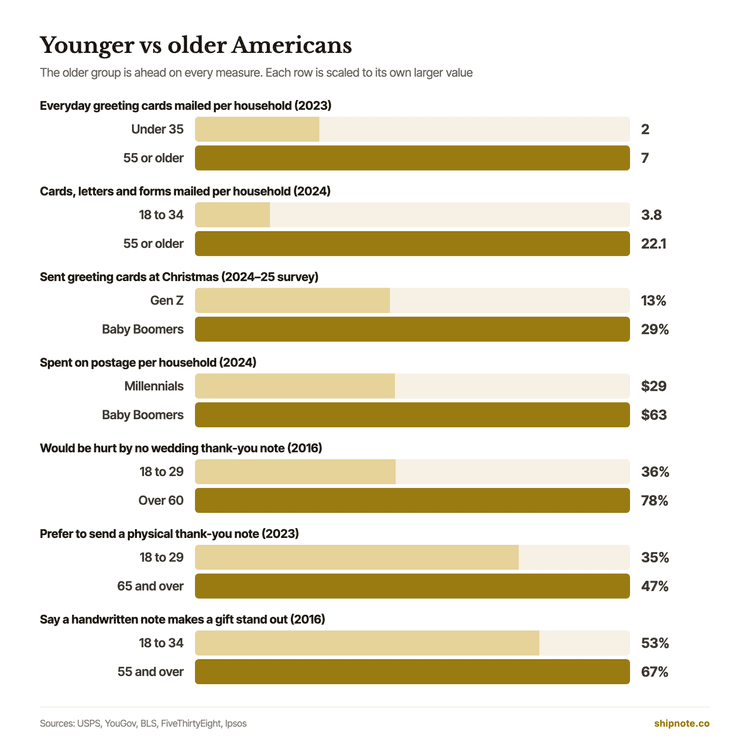
Generations follow the birth years used in US government spending data: Gen Z, born 1997 or later; Millennials, 1981 to 1996; Gen X, 1965 to 1980; Baby Boomers, 1946 to 1964. Household figures are by age of the head of household.
Sources: USPS 2023 and 2024, YouGov 2025 and 2023, BLS, FiveThirtyEight, Ipsos
Do people still send thank-you cards?
Yes, but households mailed 59% fewer everyday greeting cards in 2024 than in 2014. Thank you is the third most popular everyday card occasion, after birthday and sympathy (2020).
Greeting cards mailed per US household per year:
| Year | Everyday cards | Holiday cards |
|---|---|---|
| 2014 | 11.6 | 7.0 |
| 2019 | 8.6 | 5.2 |
| 2024 | 4.7 | 4.7 |
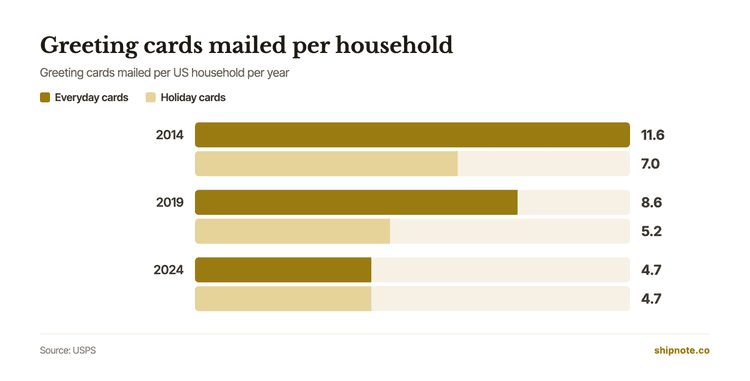
- Everyday cards fell faster than holiday cards: down 59% from 2014 to 2024, against 32%.
- US households sent and received an estimated 653 million everyday greeting cards in 2023, down from 1,143 million in 2013.
- Greeting cards are most of the cards, letters and forms households mail: 9.4 of 14.9 pieces per household in 2024.
Sources: USPS 2024, 2023 and 2013, Greeting Card Association
Which age group sends the most cards?
Households headed by someone 55 or older mailed 7 everyday greeting cards in 2023, against 2 for households headed by someone under 35. Every age group mails fewer than it did ten years earlier.
Everyday greeting cards mailed per household per year, by age of head of household:
| Age | 2013 | 2023 |
|---|---|---|
| Under 35 | 7 | 2 |
| 35 to 54 | 9 | 4 |
| 55 or older | 11 | 7 |
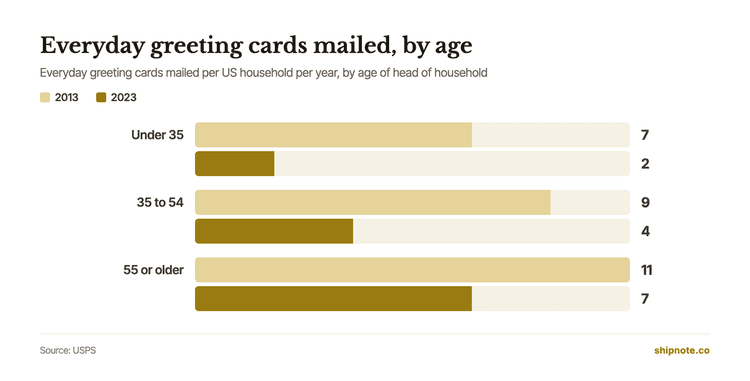
- Cards, letters and forms mailed by households headed by someone 18 to 34 fell 81% from 2014 to 2024, from 19.8 pieces a year to 3.8. For 55 or older it fell 53%, from 46.8 to 22.1.
- 29% of Baby Boomers said they sent greeting cards at Christmas, against 13% of Gen Z, in a survey running from September 2024 to September 2025.
- In a 2019 survey of 13- to 18-year-olds, 64% said they like writing and mailing cards and letters to friends and family, and nearly two-thirds send a greeting card or postcard at least several times a year. 15% had never sent a greeting card.
Figures for 2013 and 2023 are rounded to whole cards in the source. They come from a different USPS measure than the per-household trend in the previous section, so compare years within a table, not across tables.
Sources: USPS 2023, 2013 and 2024, YouGov, USPS OIG
How much does each generation spend on postage?
Baby Boomer households spent $63 on postage in 2024, more than twice the $29 spent by Millennial households.
Average annual spending per household, 2024:
| Generation | Postage | Postage and stationery |
|---|---|---|
| Gen Z | $24* | $72* |
| Millennials | $29 | $135 |
| Gen X | $35 | $115 |
| Baby Boomers | $63 | $158 |
| Silent Generation | $67 | $129 |
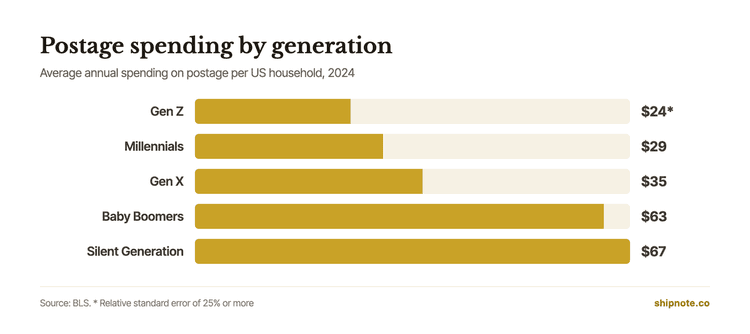
* Gen Z estimates have a relative standard error of 25% or more, so treat them as rough.
Postage includes packages mailed through USPS. The average across all households was $43 on postage and $131 on postage and stationery.
Sources: BLS spending by generation, postage
Do younger people expect a thank-you note?
78% of adults over 60 would be hurt to get no thank-you note for a wedding gift. 64% of adults 18 to 29 would not be.
Would be a little or very hurt to get no thank-you note for a wedding gift (2016):
| Age | Women | Men |
|---|---|---|
| 60 and over | 80% | 78% |
| 45 to 59 | 70% | 57% |
| 30 to 44 | 50% | 40% |
| 18 to 29 | 37% | 35% |
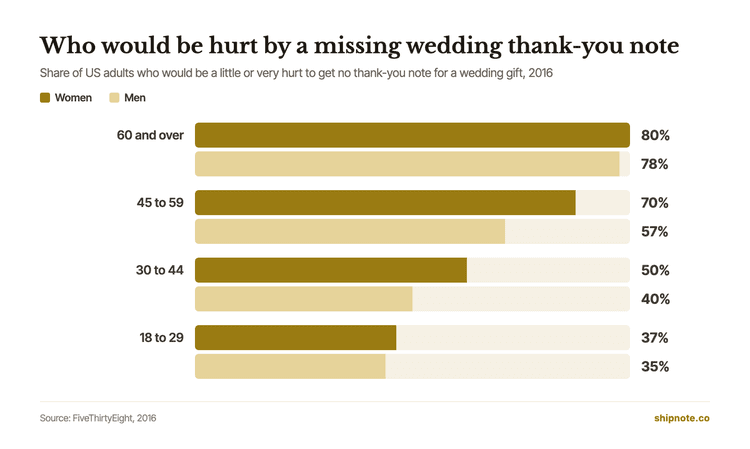
Men 45 to 59 were the strictest on timing: 56% said a wedding thank-you note is too late after a month.
The poll had 1,050 respondents, surveyed online on August 23 and 24, 2016.
Source: FiveThirtyEight
Do younger people prefer digital thank-you notes?
Not to send one. Adults 18 to 29 narrowly prefer sending a physical thank-you note, 35% to 30%, and the lead for paper grows with age, to 47% to 23% for adults 65 and over.
When you want to thank someone with a note, do you prefer to send...? (2023)
| Answer | 18 to 29 | 65 and over |
|---|---|---|
| A physical note | 35% | 47% |
| A digital note | 30% | 23% |
| No preference | 19% | 20% |
| Never send thank-you notes | 8% | 7% |
| Not sure | 7% | 3% |
- Across all adults: 42% prefer a physical note, 25% a digital one and 9% never send thank-you notes.
- When they are the ones being thanked, adults 18 to 29 split: 30% would rather get a digital note and 28% a physical one. Only 13% of adults 65 and over want a digital note, and about half of adults 45 and over have no preference.
- 61% of Americans think digital thank-you notes are more common today; 12% say physical ones are.
- 54% of couples marrying in 2025 think it should be less acceptable to send a digital thank-you card and would prefer a handwritten one.
- 59% of Gen Z and 62% of Millennials prefer receiving physical holiday cards over digital ones (2023).
The 2023 poll surveyed 12,105 US adults on June 14, 2023. The couples survey asked close to 6,000 couples marrying in 2025.
Sources: YouGov, Zola, Shutterfly
Do people send thank-you notes after a job interview?
9% of Americans say an applicant should be expected to send a handwritten thank-you note after a job interview: 14% of adults 65 and over and 7% of adults 18 to 29.
Should an applicant be expected to send the interviewer a thank-you note? (2022)
| Answer | 18 to 29 | 65 and over |
|---|---|---|
| Yes, handwritten | 7% | 14% |
| Yes, by email | 24% | 9% |
| Yes, either way | 17% | 30% |
| No | 32% | 33% |
| Not sure | 21% | 15% |
- Across all adults: 9% handwritten, 18% email, 21% either way, 36% no and 16% not sure (2022).
- 39% of Americans had sent a thank-you note or email after a job interview (2019).
- 61% of Baby Boomers and 46% of Millennials call a thank-you note or email to the interviewer good advice (2021).
Source: YouGov 2022, 2019, 2021
Do people value handwritten notes?
58% of Americans say a handwritten note makes a gift stand out: 67% of adults 55 and older and 53% of adults 18 to 34 (2016).
- 82% say handwritten notes are an important habit for a young person to cultivate; 14% call them outdated (2014).
- 15% of Americans have never written a personal letter on paper; among adults under 45, more than one in five (2021).
Sources: Ipsos, CBS News 2014 and 2021
How much does it cost to mail thank-you cards?
$0.82 a card with a Forever stamp in 2026, or $0.65 as a postcard.
A Forever stamp has cost $0.82 since July 12, 2026, and a postcard stamp $0.65. A square envelope pays the $0.49 nonmachinable surcharge on top of the stamp. Postage alone for a typical list:
| Cards | Postcards | Cards in standard envelopes | Cards in square envelopes |
|---|---|---|---|
| 25 | $16.25 | $20.50 | $32.75 |
| 50 | $32.50 | $41.00 | $65.50 |
| 100 | $65.00 | $82.00 | $131.00 |
Postage assumes each card in an envelope weighs one ounce or less.
ShipNote prints, stamps and mails photo thank-you postcards from a pasted registry or guest list: $1.99 a card on 10 or more, First-Class postage included. For how people send cards in bulk, see ShipNote order data.
Source: USPS
Sources and how to cite this page
You are welcome to quote these figures and use the charts and image on this page. If you do, please credit ShipNote and link to this page:
Source: ShipNote, Do People Still Send Thank-You Cards? Stats by Generation, https://www.shipnote.co/blog/do-people-still-send-thank-you-cards
We check every figure against its original source and update the page as new data comes out. Mail data cover 2013 to 2024, spending data 2024 and polls 2014 to 2025.
All sources, checked October 2026:
- USPS: household mail 2024, household mail 2023, household mail 2013, July 2026 prices
- BLS: spending by generation 2024, postage by generation
- USPS OIG Gen Z survey 2019
- YouGov: thank-you note preferences 2023, Christmas 2025, interview thank-you notes 2022, interview thank-you notes 2019, job advice 2021
- FiveThirtyEight
- Ipsos: release, method
- CBS News: handwritten notes 2014, personal letters 2021
- Zola First Look Report 2025
- Shutterfly 2023
- Greeting Card Association
Frequently asked questions
Do people still send thank-you cards?
Yes, but fewer every year. US households mailed 4.7 everyday greeting cards each in 2024, the category that includes thank-you cards, down from 11.6 in 2014. Thank you was the third most popular everyday card occasion in 2020, after birthday and sympathy.
Do millennials send thank-you cards?
Less often than older adults. In 2023, households headed by someone under 35 mailed 2 everyday greeting cards a year, the category that includes thank-you cards, against 7 for households headed by someone 55 or older. Millennial households spent $29 on postage in 2024, against $63 for Baby Boomer households.
Does Gen Z send thank-you cards?
Less than older generations. 13% of Gen Z said they sent greeting cards at Christmas, against 29% of Baby Boomers, in a survey run from September 2024 to September 2025. Gen Z households spent a rough estimate of $24 on postage in 2024, against $29 for Millennial households. In a 2019 survey of 13- to 18-year-olds, 64% said they like writing and mailing cards and letters.
Do young people prefer digital thank-you notes?
Not to send one. In 2023, adults 18 to 29 narrowly preferred sending a physical thank-you note to a digital one, 35% to 30%; to receive one, they split 30% digital and 28% physical. Adults 65 and over prefer sending physical, 47% to 23%.
Are thank-you cards a thing of the past?
Not yet. Everyday greeting cards mailed per household fell 59% from 2014 to 2024, but older adults still expect them: 78% of adults over 60 would be hurt to get no thank-you note for a wedding gift. 64% of adults 18 to 29 would not be.
Who sends the most thank-you cards?
Older households. In 2023, households headed by someone 55 or older mailed 7 everyday greeting cards, the category that includes thank-you cards, against 4 for ages 35 to 54 and 2 for under 35.
Is a handwritten thank-you note expected after a job interview?
Most Americans do not expect a handwritten one. In 2022, 9% said an applicant should be expected to send a handwritten note, 18% an email and 21% either one; 36% said no note should be expected.
Ready to mail your thank-yous?
First batch ships next business day. From $1.99 per card. No subscription.
Create Your Postcards