
Christmas Card Statistics 2026: Who Still Sends Them
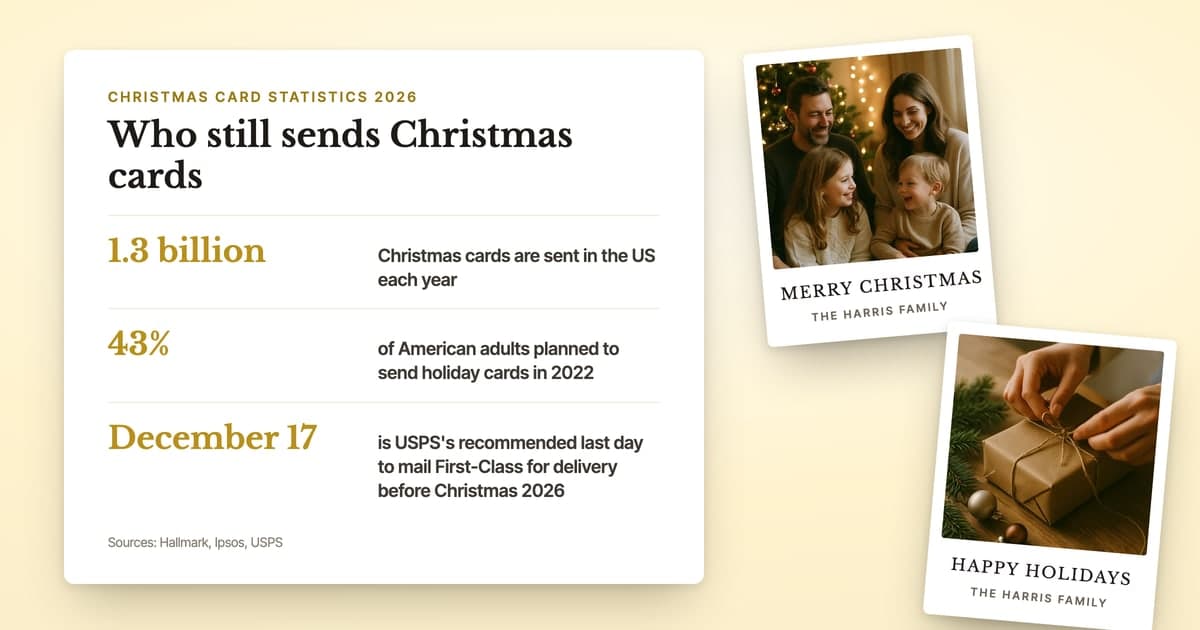
About 1.3 billion Christmas cards are sent in the United States every year, and 43% of American adults planned to send holiday cards in 2022. Households report sending fewer than they used to: 33.1 Christmas, Hanukkah and New Year's cards each in fiscal 2009, against 38.1 in fiscal 1987. This page collects the latest figures on how many Christmas cards are sent, who sends them, how sending has changed and what mailing them costs.
Every figure was checked against its source in October 2026. Sources are listed at the end of each section and in full at the end of this page.
Contents
- Key Christmas card statistics
- How many Christmas cards are sent each year?
- What are the most popular card-sending holidays?
- What percentage of Americans send Christmas cards?
- How many Christmas cards does the average household send?
- Do younger people send Christmas cards?
- Do people prefer physical or digital holiday cards?
- What holiday traditions do Americans keep?
- Are Christmas cards declining?
- Holiday mail by the numbers
- How much does it cost to mail a Christmas card?
- A short history in numbers
- Sources and how to cite this page
- Frequently asked questions
Key Christmas card statistics
- 1.3 billion Christmas cards are sent in the US each year, making Christmas the largest card-sending holiday.
- 43% of American adults planned to send holiday cards in 2022.
- December 17 is USPS's recommended last day to mail First-Class for delivery before Christmas 2026.
- 33.1 Christmas, Hanukkah and New Year's cards each were reported sent by US households in fiscal 2009, down from 38.1 in fiscal 1987.
- 56% of adults 55 and older planned to send holiday cards, against 33% of adults aged 18 to 34.
- 29% of Boomers sent greeting cards last Christmas, against 13% of Gen Z (2024-25).
- Two thirds of US adults who celebrate a fall or winter holiday prefer receiving physical holiday cards to digital ones.
- About nine times as many Christmas cards are bought each year as Valentine's Day cards.
- About 43% of all US household personal correspondence in fiscal 2018 was holiday greeting cards.
- 6.5 billion greeting cards of every kind are bought in the US each year, worth an estimated $7 billion to $8 billion.
- 16 billion pieces of mail and packages moved through USPS in the 2025 holiday season.
- $0.82 is the price of a Forever stamp for a card in an envelope since July 12, 2026; a postcard stamp is $0.65.
Sources: Hallmark, Ipsos, USPS, YouGov, OnePoll, Greeting Card Association
How many Christmas cards are sent each year?
About 1.3 billion Christmas cards are sent in the United States each year. Three estimates measure this:
| What is counted | Figure |
|---|---|
| Christmas cards sent each year | about 1.3 billion |
| Christmas cards bought each year, including boxed cards (2020) | about 1.3 billion |
| Holiday greeting cards mailed by US households (fiscal 2018) | more than 1.3 billion |
Americans buy about 6.5 billion greeting cards a year, so roughly one in five is a Christmas card.
Holiday greeting cards in US household personal correspondence, sent and received:
| Fiscal year | Holiday greeting cards |
|---|---|
| 2010 | 2,073 million |
| 2011 | 1,945 million |
| 2012 | 1,944 million |
| 2013 | 1,671 million |
Holiday greeting cards made up about 43% of all US household personal correspondence in fiscal 2018.
Sources: Hallmark, Greeting Card Association, USPS
What are the most popular card-sending holidays?
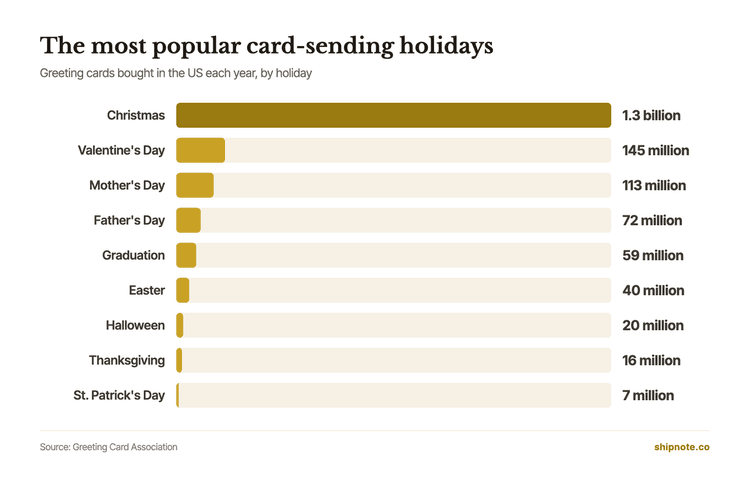
Christmas: about 1.3 billion cards a year, about nine times as many as Valentine's Day.
| Holiday | Cards bought each year |
|---|---|
| Christmas (including boxed cards) | 1.3 billion |
| Valentine's Day (not including classroom valentines) | 145 million |
| Mother's Day | 113 million |
| Father's Day | 72 million |
| Graduation | 59 million |
| Easter | 40 million |
| Halloween | 20 million |
| Thanksgiving | 16 million |
| St. Patrick's Day | 7 million |
Across all occasions, birthday is the best-selling card type, at more than half of all cards sold. The most popular everyday occasions after birthday are sympathy, thank you, wedding, thinking of you, get well, new baby and congratulations.
Nine in ten US households buy greeting cards each year, and women purchase more than 80% of them. Annual retail sales of greeting cards are an estimated $7 billion to $8 billion.
Source: Greeting Card Association
What percentage of Americans send Christmas cards?
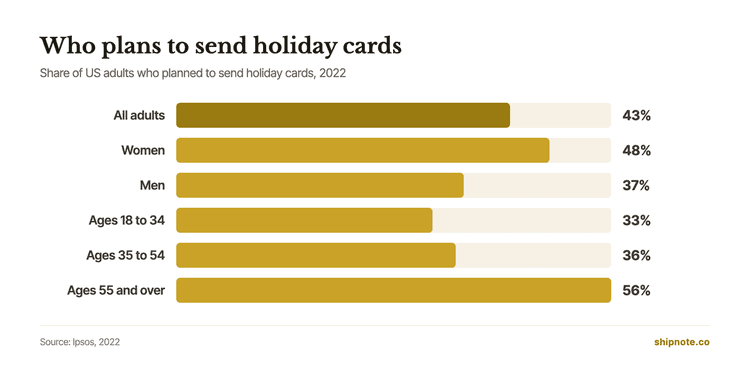
43% of American adults planned to send holiday cards in 2022. Women and adults 55 and older were more likely than men and younger adults to plan to send them:
| Group | Planned to send holiday cards |
|---|---|
| All adults | 43% |
| Women | 48% |
| Men | 37% |
| Ages 18 to 34 | 33% |
| Ages 35 to 54 | 36% |
| Ages 55 and over | 56% |
62% of Americans said sending cards is a way to stay close to friends and family. Among people planning to send cards, 85% agreed.
52% said they were likely to send holiday cards to fewer people that year.
48% said they were likely to buy rather than make their holiday gifts and cards, and 39% said they were likely to make them.
The poll surveyed 1,005 US adults online on October 4 and 5, 2022.
Source: Ipsos
How many Christmas cards does the average household send?
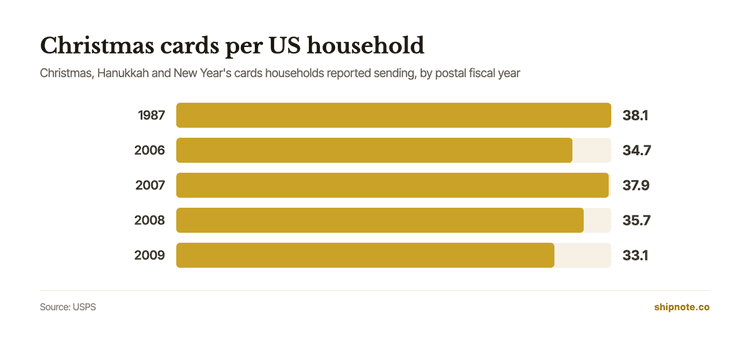
US households reported sending 33.1 Christmas, Hanukkah and New Year's cards each in fiscal 2009, down from 38.1 in fiscal 1987.
| Postal fiscal year | Cards households reported sending |
|---|---|
| 1987 | 38.1 |
| 2006 | 34.7 |
| 2007 | 37.9 |
| 2008 | 35.7 |
| 2009 | 33.1 |
Higher-income households report sending the most:
| Household income | Cards reported per household, fiscal 2009 |
|---|---|
| Under $7,000 | 16.7 |
| $35,000 to $49,999 | 29.4 |
| $65,000 to $79,999 | 37.7 |
| $100,000 or more | 49.7 |
Source: USPS
Do younger people send Christmas cards?
Younger adults send fewer holiday cards in each of these measures:
| Measure | Younger | Older |
|---|---|---|
| Sent greeting cards last Christmas (2024-25) | Gen Z: 13% | Boomers: 29% |
| Planned to send holiday cards (2022) | Ages 18 to 34: 33% | 55 and over: 56% |
| Holiday greeting cards households recorded sending per year, mail diaries (fiscal 2013) | Head of household 35 or younger: 9 | 55 or older: 17 |
Christmas, Hanukkah and New Year's cards households reported sending, by age of head of household (postal fiscal years):
| Age | 1987 | 2007 |
|---|---|---|
| 18 to 21 | 17.6 | 15.2 |
| 22 to 24 | 19.7 | 19.7 |
| 25 to 34 | 31.9 | 30.6 |
| 35 to 44 | 35.2 | 36.7 |
| 45 to 54 | 42.0 | 34.4 |
| 55 to 64 | 45.4 | 40.0 |
| 65 to 69 | 45.9 | 40.9 |
| 70 to 74 | 44.9 | 44.5 |
62% of millennials and 59% of Gen Z favored physical holiday cards over digital ones (2023).
Millennials spent an average of 27 minutes picking out a holiday card (2023).
Baby Boomers buy the most greeting cards. Millennials have spent the most money on them since 2015, averaging $6 a card (2020).
Sources: YouGov, Ipsos, USPS, OnePoll, Greeting Card Association
Do people prefer physical or digital holiday cards?
Two thirds of US adults who celebrate a fall or winter holiday prefer receiving physical holiday cards to digital ones (2023).
- 60% say receiving cards and letters in the mail "means more to me" than an email (2020).
- 65% agree that receiving cards and letters in the mail lifts their spirits (2020).
- 8 in 10 agree that greeting cards cannot be replaced by social media.
- 75% of consumers who send holiday cards say they do so because they know how good it feels to receive one.
- E-cards and mobile cards are only a very small share of greeting card sales.
Sources: OnePoll, Greeting Card Association
What holiday traditions do Americans keep?
85% of consumers say they always send Christmas cards, letters or photos during the holiday season.
| Activity | Say they always do it during the holiday season |
|---|---|
| Wrap presents | 98% |
| Decorate inside their homes | 90% |
| Decorate a Christmas tree | 88% |
| Send Christmas cards, letters or photos | 85% |
Source: Hallmark
Are Christmas cards declining?
Households reported sending 33.1 holiday cards each in fiscal 2009, down from 38.1 in fiscal 1987.
- Holiday greeting cards in household personal correspondence fell from 2,073 million in fiscal 2010 to 1,671 million in fiscal 2013, down 19%.
- In a separate count of cards mailed, households mailed more than 1.3 billion holiday greeting cards in fiscal 2018, up 3.8% over the previous three years.
- 52% of Americans said they were likely to send holiday cards to fewer people in 2022.
- First-Class Mail volume fell 2.2 billion pieces, or 5.0%, in fiscal 2025.
Holiday mail by the numbers
- 16 billion pieces of mail and packages moved through USPS between November 15, 2025 and January 9, 2026.
- 2.5 days was the average delivery time over that season, down from 2.8 days the season before.
- The week of December 15 was expected to be the busiest week of 2025 for customer traffic at Post Offices.
- December 17, 2026 is USPS's recommended last day to mail First-Class for delivery before December 25.
Source: USPS
For how USPS's on-time delivery held up over the last six holiday seasons, week by week, see our holiday mail delays data.
How much does it cost to mail a Christmas card?
$0.82 with a Forever stamp in 2026, or $0.65 as a postcard.
A Forever stamp has cost $0.82 since July 12, 2026, and a postcard stamp $0.65. A square envelope pays the $0.49 nonmachinable surcharge on top of the stamp. Postage alone for a typical list:
| Cards | Postcards | Cards in standard envelopes | Cards in square envelopes |
|---|---|---|---|
| 25 | $16.25 | $20.50 | $32.75 |
| 50 | $32.50 | $41.00 | $65.50 |
| 100 | $65.00 | $82.00 | $131.00 |
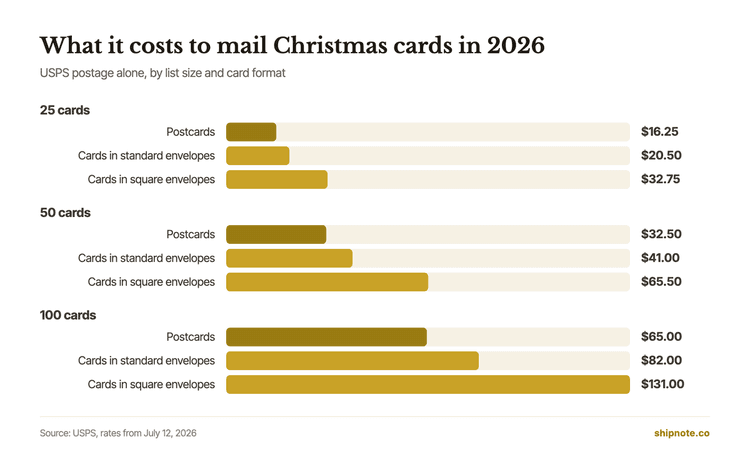
Postage assumes each card in an envelope weighs one ounce or less.
The price of a Forever stamp each Christmas season:
| December | Forever stamp |
|---|---|
| 2016 | $0.47 |
| 2017 | $0.49 |
| 2018 | $0.50 |
| 2019 | $0.55 |
| 2020 | $0.55 |
| 2021 | $0.58 |
| 2022 | $0.60 |
| 2023 | $0.66 |
| 2024 | $0.73 |
| 2025 | $0.78 |
| 2026 | $0.82 |
Every First-Class letter rate since 1863 is in our stamp price history.
ShipNote prints, addresses, stamps and mails photo holiday cards from a pasted list: $1.99 a card on 10 or more, First-Class postage included. To arrive by Christmas, order by December 14, 2026.
Source: USPS
A short history in numbers
- 1843. Henry Cole, the founding director of London's Victoria and Albert Museum, commissioned the first Christmas card. The artist John Callcott Horsley designed it, a thousand copies were printed, and they sold for a shilling each, a high price at the time.
- 1915. Hallmark made its first Christmas cards, five years after the company was founded.
- 1987. US households reported sending 38.1 Christmas, Hanukkah and New Year's cards each.
- 2018. US households mailed more than 1.3 billion holiday cards in a year.
Sources and how to cite this page
You are welcome to quote these figures and use the charts and image on this page. If you do, please credit ShipNote and link to this page:
Source: ShipNote, Christmas Card Statistics 2026, https://www.shipnote.co/blog/christmas-card-statistics
We check every figure against its original source and update the page as new data comes out. The card-industry fact sheet is from 2020; household mail data cover 1987 to 2018. For our own data on how people send cards in bulk, see ShipNote order data.
All sources, checked October 2026:
- Hallmark
- Ipsos
- YouGov
- OnePoll
- Greeting Card Association
- USPS: household mail 2007, household mail 2009, household mail 2012, household mail 2013, holiday cards 2018, 2025 results, holiday season 2025, busiest week, mailing dates, July 2026 prices, Notice 123
- V&A
Frequently asked questions
How many Christmas cards are sent each year?
About 1.3 billion in the United States. Card-industry figures count some 1.3 billion Christmas cards bought a year, and US households mailed more than 1.3 billion holiday greeting cards in fiscal 2018.
What percentage of people send Christmas cards?
43% of American adults planned to send holiday cards in October 2022. Adults 55 and older were the most likely, at 56%, against 33% of adults aged 18 to 34.
How many Christmas cards does the average household send?
US households reported sending 33.1 Christmas, Hanukkah and New Year's cards each in fiscal 2009, down from 38.1 in fiscal 1987. Households with incomes of $100,000 or more reported the most, at 49.7.
Do younger people still send Christmas cards?
Fewer of them do. In 2024-25 survey data, 13% of Gen Z sent greeting cards last Christmas against 29% of Boomers, and in a 2022 poll 33% of adults aged 18 to 34 planned to send holiday cards. In a 2023 survey, 62% of millennials and 59% of Gen Z favored physical holiday cards over digital ones.
Are Christmas cards dying out?
Households reported sending 33.1 holiday cards each in fiscal 2009, against 38.1 in fiscal 1987, and holiday greeting cards in household personal correspondence fell from 2.07 billion in fiscal 2010 to 1.67 billion in fiscal 2013. In a separate count of cards mailed, households mailed more than 1.3 billion in fiscal 2018, up 3.8% over the previous three years.
When is the last day to mail Christmas cards in 2026?
USPS recommends mailing First-Class by December 17, 2026 for delivery before Christmas.
Ready to mail your thank-yous?
First batch ships next business day. From $1.99 per card. No subscription.
Create Your Postcards