
Bar and Bat Mitzvah Thank-You Cards for 150 Guests
![Three thank-you postcards fanned out beside a gift log listing a check, a savings bond and a gift card, above a single template message reading 'Dear [RECIPIENT], thank you so much for the [GIFT_NAME]'](/_next/image?url=%2Fblog%2Fheroes%2Fbar-mitzvah-thank-you-cards-hero.jpg&w=3840&q=75&dpl=dpl_7CPhUb25y1unhz8gFydodUyCuUuo)
Your kid read from the Torah, the party was good, and there are now somewhere around a hundred and fifty people to thank. Some gave checks. Some gave savings bonds. A few sent something from an online store you have never heard of. The addresses are spread across an invitation spreadsheet, a stack of cards, and your mother-in-law's memory.
The hard part of bar and bat mitzvah thank-you cards is not the wording. Every guide you find is a list of sentences to copy. There are a few below too, but they are the easy part: what you need is a plan for a hundred and fifty names and a gift log that is already going stale.
Below: where the list actually comes from, what to do about the fact that most of the gifts were money, example wording for checks, bonds, gift cards and guests who travelled, who should be writing these, and how to get them into mailboxes without addressing a single envelope. It all works the same for a bar mitzvah, a bat mitzvah, or a b'nai mitzvah where siblings share the day.
First, where these cards are going
Thirty seconds of context, because it shapes the rest of this.
ShipNote turns a list into mailed postcards. You pick a card, write one message and add your return address. Then you paste what you have — a spreadsheet, a column of names and addresses, a jumble copied out of your invitation tracker — and an AI parser pulls out three things per person: their name, the gift they gave, and their address.
After that, you pay. Each card is printed, stamped and mailed for you: real postcards, not email. They go out the next business day and arrive in 4-7 business days. It's $2.49 a card, or $1.99 each once you're sending ten or more — and at mitzvah scale you are very much sending more than ten.
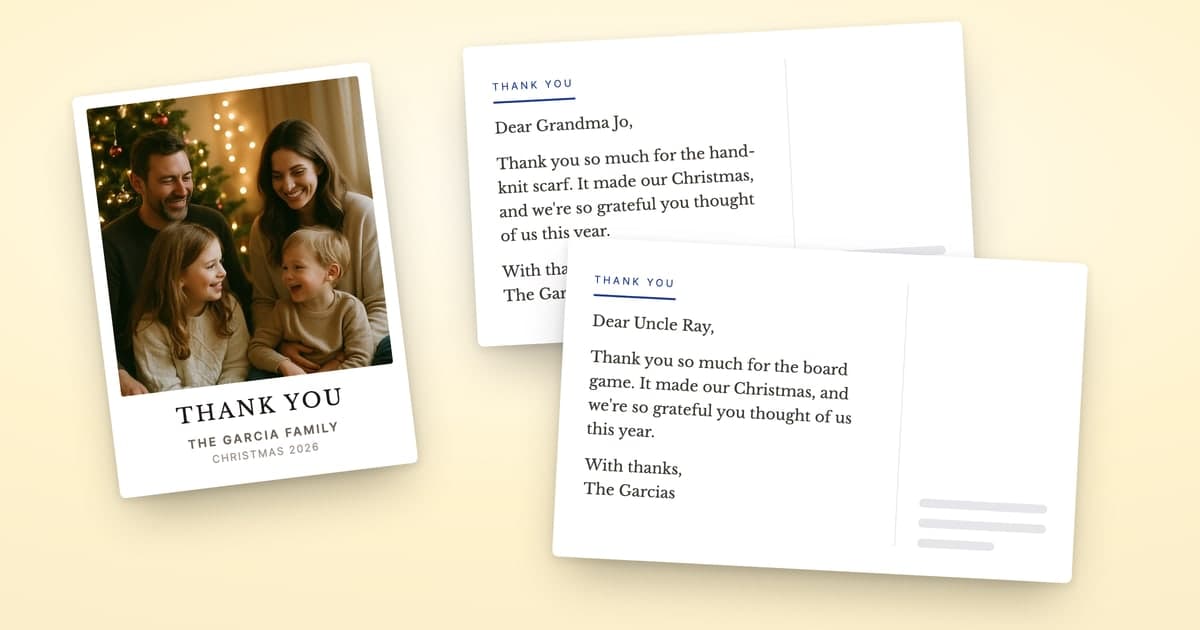
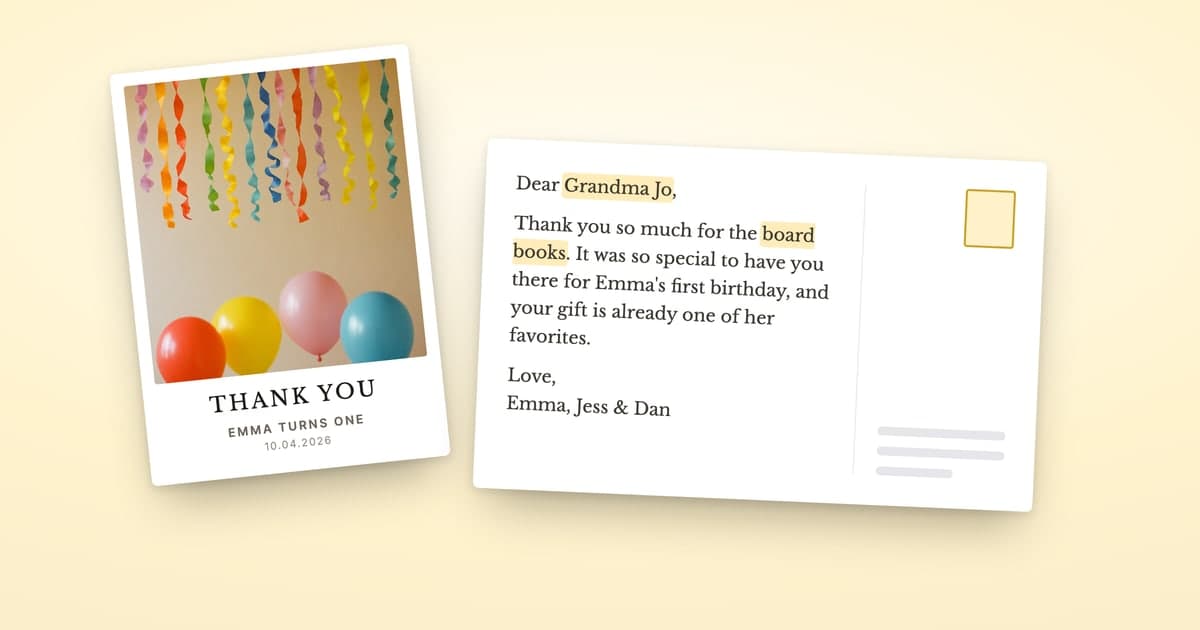
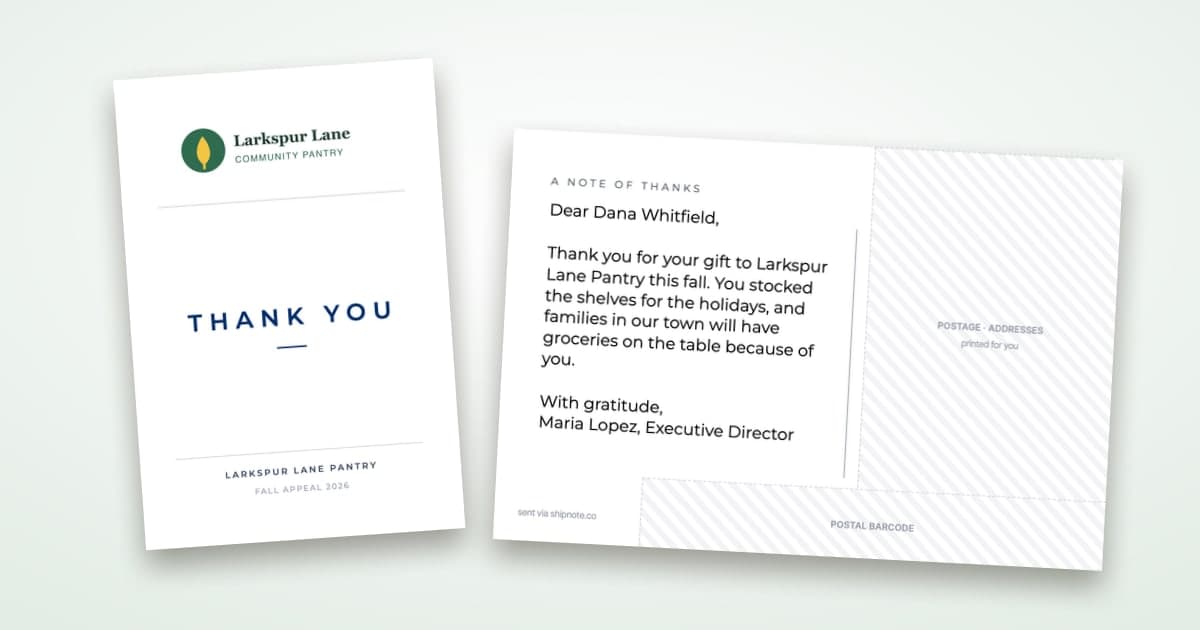
Start from the bar and bat mitzvah cards: a Star of David card, the thank-you set, and a starter message that thanks each guest for their gift without saying bar, bat or b'nai, so it reads right for all three.
The thing that matters for this particular job: you write one template, and each card renders with that person's name and their gift. So the two facts that make a mitzvah note land — who this is, and what they actually gave — are handled per card without you writing a hundred and fifty of them.
Where does the list come from? There's no registry
This is the real difference between a bar or bat mitzvah and a wedding, and it's why the registry advice everywhere else doesn't help you.
A wedding couple can export a list of who bought what. You have no such file. What you have instead is better than you think, in three pieces:
The invitation list. Whatever you used to mail 150 invitations is already 150 names and addresses. It is the single most valuable file in this process and you already own it. Start here, always.
The gift log. Somebody wrote down who gave what — a notebook at the party, a running note on a phone, cards saved in a shoebox. If nobody did, do it now, before another week passes. This is the piece that decays, and it decays fast.
The people who didn't come. Grandparents who couldn't travel, your father's colleague, the cousin in Israel. They sent gifts and they are not on the invitation list in the same way. Usually a short list, but it's the one most likely to get missed entirely, and missing it is the failure people remember.
Join those three and you have your batch. It does not need to be clean — one column of names, one of gifts, one of addresses is plenty, and the parser handles messier than that.
What do you write when the gift was a check?
At a bar or bat mitzvah, most of them are. This is the part the wording lists handle badly, because their examples assume a physical object.
Never name the amount. No "thank you for the $180." It reads like a receipt, and it invites comparison between guests who will absolutely talk to each other.
Write about what it's for, not what it was. "Thank you for the generous gift — it's going into the account for my trip to Israel next summer" is a real thank-you note. "Thank you for the check" is not. The giver wants to know the money became something.
If you haven't decided yet, don't manufacture a plan. "Your generous gift" is complete, normal, and what most of these notes say. A vague truth beats a specific invention.
One practical note if you're using a template: the gift name prints after the word the, so it needs to read as speech. "Thank you so much for the generous gift" works. "Thank you so much for the $100 check" does not. The parser handles most of this when it reads your list: a bare dollar amount like "$180" comes back as "generous gift", and a gift card keeps its brand, so "Amazon.com Gift Card 25.00 USD" pasted out of a confirmation email should come back as "Amazon gift card". Read down the gift column before you pay anyway, and fix anything that wouldn't sound right said out loud. For cash, "generous gift" is almost always the right entry.
Bar and bat mitzvah thank-you card wording
One message goes on every card, and ShipNote fills in two things per person: [RECIPIENT] becomes the name as it reads in your list, and [GIFT_NAME] becomes their gift, right after "the". [YOUR NAME] fills in from the name on your return address, so if the cards should be signed by your kid, type their name in its place. A template that reads right whatever the gift was, and whether or not the guest came:
Dear [RECIPIENT],
Thank you so much for the [GIFT_NAME] for my bat mitzvah. It meant so much to me, and I'm really grateful.
Love, [YOUR NAME]
For Aunt Sharon, whose line in the gift log says "generous gift", that card reads "Dear Aunt Sharon, Thank you so much for the generous gift for my bat mitzvah." Swap in "bar mitzvah" or "b'nai mitzvah" as yours was.
Then open the cards that deserve more and add a line after the thank-you. Each card opens with the name and gift already filled in, so you are editing that card's own text. Here is how four common ones can read after the edit:
A check or cash (gift column: "generous gift"):
Thank you so much for the generous gift. I'm putting it toward my trip to Israel next summer, and I'll think of you when I'm there.
A savings bond or Israel bond (gift column: "savings bond" or "Israel bond"):
Thank you so much for the savings bond. My parents are keeping it safe until I'm older, and it means a lot that you were thinking that far ahead for me.
A gift card (gift column: "Target gift card"):
Thank you so much for the Target gift card. I've already picked out new headphones with it, and I'll think of you every time I use them.
A guest who travelled (any gift):
Thank you so much for the generous gift, and for coming all the way from Chicago to be there. Seeing you there meant a lot.
Keep the amount out of all of them, for the reason above. The travel line is the one to save for the people it's true of. A thank-you that thanks someone for a trip they didn't make is worse than the plain template.
Who actually writes them
The kid. That is the entire point of the exercise, and a twelve- or thirteen-year-old's slightly stiff phrasing is a feature rather than a problem to edit out. A note that has clearly been rewritten by a parent reads worse than an awkward one.
But "the kid writes them" does not have to mean the kid does the logistics, and conflating those two is how families end up with a box of unwritten cards in March. A workable split:
- Parents build the list, match gifts to names, chase the missing addresses, and handle the mailing.
- The kid writes the message, and personalizes the ones that deserve it.
Which brings up the only real strategy question here.
Personalize some, not all
A hundred and fifty individually composed notes is the plan that fails. It fails in week three, and the last sixty people get nothing.
The workable version: one good template covers everyone, and then you spend real writing on the fifteen or twenty people who deserve more than a template. The grandparents. The aunt who flew in from Chicago. The tutor who spent a year on the Torah portion. The friend who was on the dance floor all night.
Everything else goes out with the person's name and their gift in it, which is already a genuine thank-you note. The card that arrives is worth infinitely more than the perfect one that never got written.
In practice that means writing one message, then opening the fifteen cards you want to rewrite and rewriting them. Any card can be edited individually and reset back to the template if you change your mind.
How long do you actually have?
The convention most mitzvah guides give is within a month, and two weeks is better.
Treat that as a practical deadline rather than an etiquette one. The clock that matters is the gift log going fuzzy: a week after the party you know exactly who gave the bond, and six weeks later you are guessing. Every day you wait makes the notes vaguer, and vagueness is the thing that makes a thank-you feel like a form letter.
If you're already past a month, send them anyway. A late thank-you note is received well. A missing one is noticed for years.
Step by step
- Open the invitation spreadsheet. That's your address book, already built.
- Write down the gift log now, before another week goes by. Names against gifts, however rough.
- Add the people who sent gifts but didn't attend. Short list, easy to miss.
- Write the gifts the way you'd say them — "generous gift" for checks and cash.
- Pick a card from the bar and bat mitzvah set in ShipNote.
- Write one message using the name and gift placeholders, and add your return address.
- Paste the list. The parser splits name, gift and address per person.
- Rewrite the fifteen that deserve it. Leave the rest on the template.
- Pay. $1.99 a card on ten or more.
- Cards print and mail the next business day and land in 4-7 business days.
Related reading
- Can ChatGPT Write Your Thank-You Cards? — the prompt that produces a template for a whole batch instead of one perfect note.
- Do Thank-You Cards Have to Be Handwritten? — the question every family asks at about card forty.
- Is It Too Late to Send Thank-You Cards? — written for weddings, but the lateness math is the same.
- The Cheapest Way to Mail Thank-You Cards — what 150 cards actually costs, every route compared.
- Hanukkah Cards, Printed and Mailed — the same guest list again in December: Happy Hanukkah cards, and a Hanukkah thank-you that names each gift.
Ready to mail your thank-yous?
First batch ships next business day. From $1.99 per card. No subscription.
Create Your PostcardsCommon questions
The convention most mitzvah guides give is within a month of the simcha, and two weeks is better. The reason to move fast is practical rather than ceremonial: the gift log is accurate the week after the party and decays from there. Once you can no longer remember which cousin gave the savings bond, every note gets vaguer, and vague is what makes a thank-you note feel like a form letter.
The kid writes them — that is the whole point, and a twelve- or thirteen-year-old's slightly awkward phrasing is a feature. What parents can reasonably own is the logistics: building the list, matching gifts to names, chasing the addresses, and getting the cards into the mail. Splitting it that way is usually the difference between notes that go out and notes that don't.
Never name the amount. Write about what it is for rather than what it was — a first savings account, a trip, a camera — because that is the part the giver actually wants to hear. If you have not decided yet, 'your generous gift' is a complete and normal thing to write, and it is what most of these notes say.
Yes. Pick a card, write one message with the name and the gift filled in per person, then paste the list — names, gifts and addresses in whatever shape you already have them — and each card is printed, stamped and mailed for you. There are no envelopes to address because there are no envelopes; they mail as postcards at $1.99 each on ten or more.
The invitation list. Whatever you used to mail 150 invitations already holds 150 addresses, and that spreadsheet is the single most useful file in this whole process. Gifts that arrived from people who did not attend get added by hand — that is usually a short list.