

When should you send wedding thank-you cards?
Send a thank-you card within three months of the wedding — and within two weeks for gifts that arrive before it, so the giver knows the package landed. Every gift gets a card: physical, cash, group, and gifts from guests who couldn't attend.
The golden rule of our etiquette guide is blunt: every gift deserves a note, including monetary gifts, gifts from people who couldn't make it, and the bigger gestures like hosting your shower. Gifts that arrive early get thanked early; they don't wait for the wedding.
Who writes them? Traditionally each partner covered their own side of the guest list; most couples now just split the list evenly, or split tasks — one writes while the other handles addresses. Both names appear on every card regardless of whose hand (or keyboard) produced it.
Here is every timing rule in one table — the etiquette deadline next to the honest one:
| When the gift arrived | Etiquette deadline | Realistically fine until |
|---|---|---|
| Before the wedding (shipped early) | 2 weeks after it arrives | The wedding itself — nobody is checking postmarks |
| At the shower | ~2 weeks after the shower | A month or two — your shower host deserves the faster note |
| On or after the wedding day | Within 3 months of the wedding | ~6 months, no apology line needed |
| Opened or discovered late | As soon as you find it | Whenever you find it — a kind, honest note beats silence |
| It's already been a year | Long past — and it still counts | Send it anyway: one apology line, then real gratitude |
The “realistically fine” column is our honest read, not official etiquette — late always beats never.
Read the full guide: wedding thank-you note etiquette — it also covers the awkward cases: group gifts, gifts you didn't love, and the package that arrived with no card attached.
What do you write in a wedding thank-you card?
Three to five sentences with six beats: greet them by name, thank them for being there (or for sending the gift), name the specific gift, say how you'll use it, add one forward-looking line, and close warmly with both your names. Specific beats long, every time.
Our wording guide breaks that structure into five fill-in-the-blank templates — for a physical gift, a cash gift, a guest who couldn't attend, a group gift, and the friend who helped pull the day off. Each is four sentences you can adapt in under a minute.
The two rules people trip on: for cash, never mention the amount — name what the money is going toward instead. And don't pad for length; a labored page reads worse than four sincere sentences that prove you remember exactly what they gave.
Read the full guide: what to write in a wedding thank-you note — all five templates, ready to copy.
Two questions surface once the templates are open. Whether the card has to be in your own hand: the real rule on handwritten versus printed wedding thank-you cards is that etiquette asks for prompt, personal and specific — not perfect penmanship. And what to do about the guest who arrived empty-handed: sending a thank-you card when there was no gift covers who still gets one, and the one line that makes it land wrong.
Shower gifts come first, and they get the faster note. For the registry gift, the handmade gift and the host who threw the party, bridal shower thank-you messages has 50 to copy.
Is it too late to send wedding thank-you cards?
No — it is never too late, and a late card always beats no card. Past three months, just send it. Past six months, add one short line acknowledging the delay. Even at a year, lead with a brief apology, then real, specific gratitude. Don't grovel.
Our late-cards guide maps every delay window: four to five months is barely late and needs no apology; at six months one acknowledging sentence is plenty; at nine to twelve months you add a brief apology and extra warmth. There is no row on that table where the answer is “skip it.”
At the twelve-month mark the wording shifts slightly: open with one line like “we owe you a much earlier thank-you,” then make the gratitude specific enough to prove you remember the gift. Long apologies shift the weight onto the reader — and a first-anniversary photo on the card acknowledges the time without making lateness the topic.
Read the full guides: is it too late to send wedding thank-you cards for the month-by-month playbook, and wedding thank-you cards a year later for wording that works at twelve months.
What's the fastest way to send all of them?
Batch everything through a print-and-mail service. Write one template message, paste your registry's gift list, let AI extract every giver and gift, and the whole pile is printed, stamped, and mailed the next business day — about 15 minutes of work versus 8–15 hours of handwriting.
Handwriting 100 notes runs 8–15 hours of writing, envelope addressing, and stamping, before the post-office trip. Assembly-line batching and hybrid pre-printed stationery shave hours off; emailed thank-yous save the most time but aren't recommended for wedding gifts.
The batch flow looks like this: write one template with [name] and [gift] placeholders, then copy your registry's gift list and paste it into ShipNote — AI extracts every giver, gift, and shared address into a recipient list. Personalize the few cards that deserve an extra line, and every card mails the next business day, arriving in 4–7 business days.
The card itself, a 4x6 postcard with your photo on the front and each guest's own note on the back, is on our thank-you postcard page. Designed the front in Canva already? Upload it as your front; Canva's own print service ships the cards to you rather than to your guests.
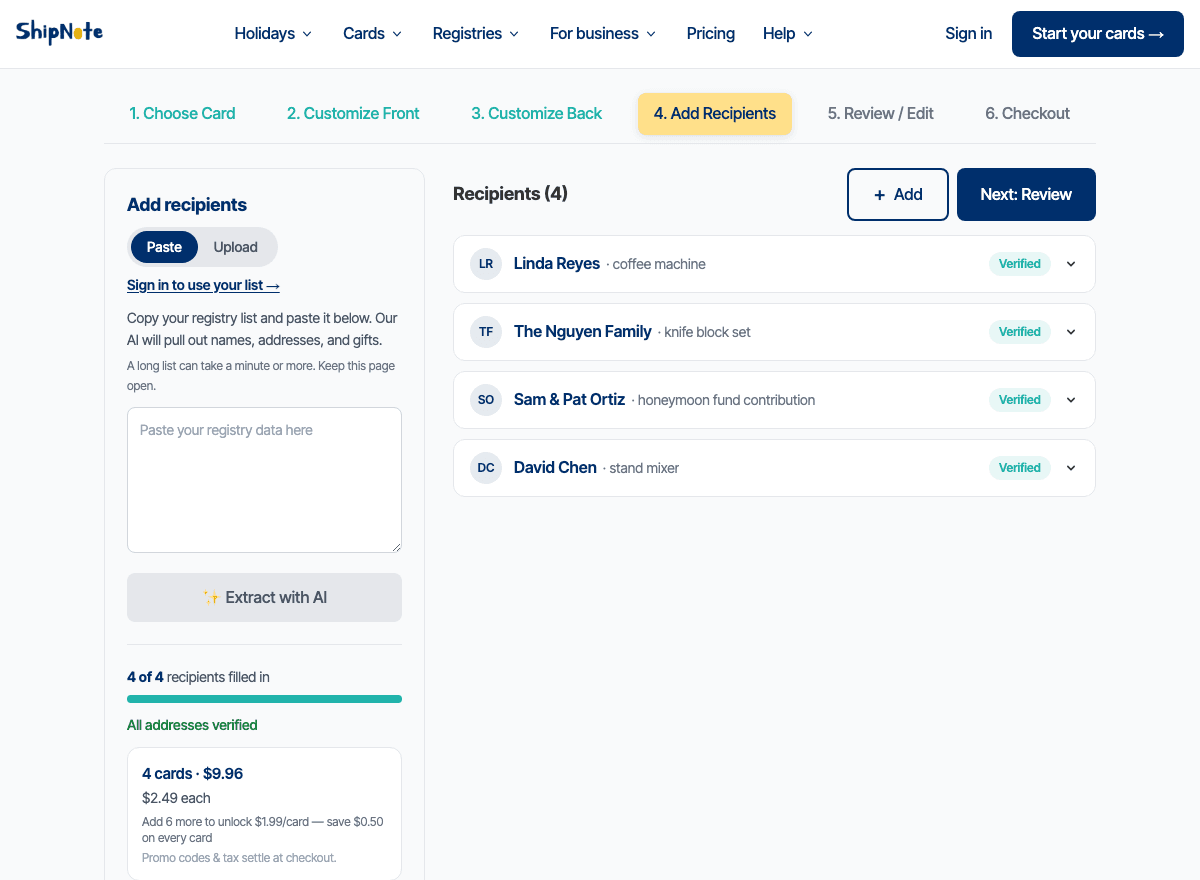
What does mailing the batch actually cost? Here are the real numbers for 50 and 100 cards — and if you're stamping envelopes yourself, our stamp calculator for cards totals the exact postage for any quantity and format:
| Method | 50 cards | 100 cards | Your time |
|---|---|---|---|
| DIY: boxed cards + stamps + addressing | $83–$191 | $165–$382 | 4–8 hours (50) · 8–15 hours (100) |
| ShipNote print-and-mail postcards | $99.50 | $199 | ~15 minutes total |
Assumptions: DIY priced at $1–$3 per boxed card plus $0.65 (postcard stamp) to $0.82 (letter stamp) postage; your addressing time isn't priced in. ShipNote is $2.49 per card — from $1.99 per card for 10+, delivery included (printing, addressing, postage, and next-business-day mailing).
Of the thank-you card services that mail a whole list of personalized cards for you, ShipNote is the cheapest: every other one we priced costs more for the same batch. See the side-by-side prices.
Handwriting anyway? Run it as an assembly line. Batch by task, not by card: write 20 messages in one sitting, address 20 envelopes in the next — switching tasks per card is where whole afternoons vanish. Split the work by task with your partner (one writes, one addresses and stamps; both names sign every card), keep a giver / gift / sent? list so nobody gets two cards or none, and buy postage once for the exact batch.
How do you get guest addresses from your registry?
Registries track who gave what, but most don't hand you mailing addresses. The pattern that works: copy the gift-tracker list for names and gifts, then pull addresses from the guest-list or RSVP tool you used for invitations — and fill the last few gaps inline as you go.
Zola is the exception: its downloadable gift file includes each giver's address, so only the gaps need its guest-list/RSVP tool. The Knot doesn't: its Track Gifts page lists the gift and date — and the giver, for its own-store items, cash funds, and “Add to The Knot” gifts — while addresses sit in its separate guest-list tool.
Amazon's Thank You List sometimes includes the address — when the giver shipped the gift directly to you and shared their details — and shows a “Why no address?” link when it can't. Crate & Barrel's Thank You Manager shows whatever each purchaser volunteered at checkout: some share name, address, and email; others only a name.
And if gifts came in across two or three platforms, consolidate before you write: pick one source of truth, export each registry's gift data, reconcile duplicates and gaps, then send the thank-yous as one batch instead of eighty one-offs.
Read the full walkthroughs: how to send thank-you cards from your Zola registry, how to send thank-you cards from The Knot registry, how to send thank-you cards from your Amazon registry, how to send thank-you cards from your Crate & Barrel registry, and manage gifts from multiple registries for the consolidation playbook.
Which registry is best for thank-yous?
For the after-the-wedding work, Zola is the strongest pick: its downloadable gift file includes each giver's address, so the list you export is the list you mail from, plus a polished post-event tracker. The Knot wins on retailer breadth, and Amazon publishes no expiration for its registry — though its 20% completion discount only runs 90 days after the event.
Our head-to-head comparison calls it honestly: both Zola and The Knot are free, both support universal-add, and — since The Knot matched Zola in June 2026 — both now offer zero-fee Venmo cash funds and the same 20% own-store completion discount. What still separates them for thank-you season is where the addresses land: Zola's export includes each giver's address, so one file feeds your cards, while The Knot keeps addresses in a separate Guest List Manager. The Knot counters with the broadest retailer network and the most established wedding-website integration.
Amazon plays by different clocks. It publishes no expiration for the registry itself, but the 20% completion discount runs 90 days from your event (up to $300 in savings), registry returns close 180 days after delivery, and the thank-you etiquette clock — about three months — keeps its own time entirely.
Read the full comparisons: Zola vs The Knot wedding registry, Honeyfund vs Zola cash-fund fees and how long does an Amazon wedding registry last.
Wedding thank-you card FAQ
How long do you have to send wedding thank-you cards?
Three months from the wedding is the traditional deadline, and two weeks for gifts that arrive beforehand. Those are targets, not expiration dates: a card at six months needs one acknowledging line, and a card at a year still lands warmly. No window makes a thank-you unsendable.
Do you send a thank-you card for cash gifts?
Yes — cash gifts get the same card as physical ones. Never mention the dollar amount. Instead, name what the money is going toward: “your generous gift is going straight into our honeymoon fund.” Specificity about the use reads as more personal than any number could.
Do wedding thank-you cards have to be handwritten?
No. Modern etiquette accepts typed and printed cards — including photo postcards — as long as each message is personal and names the specific gift. The real taboo is the generic pre-printed card with no personalization. A typed, specific message reads as more thoughtful than a handwritten generic one.
What if you lost track of who gave what?
Your registry probably still knows, but copy the list now: not every registry keeps it forever. Target lets you sign in and review a registry for 18 months after the event date, and when a store linked to The Knot stops syncing, its gifts drop off Track Gifts (Williams Sonoma's brands did in May 2025). Zola says its registry never expires, and Amazon publishes no expiration. For off-registry gifts, check the card box, gift receipts, and your bank's deposit records.
How much does it cost to mail wedding thank-you cards?
DIY runs about $1.65 to $3.82 per card — $1–$3 for the card plus $0.65–$0.82 postage — before you price your addressing time. A print-and-mail service like ShipNote is $2.49 per card, dropping to $1.99 on orders of 10 or more, with postage and mailing included.
Ready to get them in the mail?
Pick a postcard, write one template, paste your registry — we print, stamp, and mail every card next business day. From $1.99 per card on 10+, delivery included.
Start your batch